Author: Carla Doria

  • I’m back

    I can’t believe it’s been almost two years since my last post. My day job was intensive, but other than that, I just felt I didn’t have anything interesting to say from a writer’s perspective. My first novel was published, and I entered a sort of writing hiatus. Then, last year, I started to write again. It felt good, but I still didn’t have anything compelling to share on my writing blog. Now, my circumstances have changed.

    AI image generated by Midjourney

    I’m in the process of transitioning from a very demanding job to finally having more time for my personal projects, one of which is writing. Last year, I started another fiction novel—a dystopian story. Different from The Last Families, I didn’t want this new novel to have multiple points of view and to be so complex. I wanted a simpler story, but a good one. I’ve already picked a name for this novel, although I’m very far from publishing it. I’m currently in the first round of beta readers and receiving so much good feedback. I’m in no hurry to publish this time. This novel is called “When the World Disappears,” and it is a dystopian story set in Bolivia, in a world following the aftermath of a pandemic (yes, I couldn’t help but get inspiration from Covid 😄 ). It has quite interesting twists. I will soon give more details.

    This writing cycle has been different. Although I’ve only published one book, I’ve learned a great deal from the process of writing and self-publishing The Last Families. These are some of the lessons:

    • Fantasy, and especially high fantasy, can be hard to achieve. If this is your genre, I recommend simplifying the characters and the plot because the world-building of high fantasy is very complex already. While some, like Tolkien, have achieved this art, he devoted most of his life to endless manuscripts that his son then had a hard time compiling. As someone without any descendants, I don’t have the luxury of relying on future generations for compilations. Next time I choose to write fantasy, I’ll aim for a simpler plot.
    AI image generated by Midjourney
    • Multiple points of view are hard—very hard. The only way to achieve them is to analyze each character deeply and be crazy enough (in a good manner) to jump from one character’s head to the other. One of the best pieces of feedback that I got from The Last Families was that I’ve managed to achieve good character development in spite of the multiple points of view, but it was so difficult that I’m not looking to revisit this approach in at least a decade.
    • Get beta readers very soon, and as many as possible. As a first-time writer, I felt very protective of my first novel and very insecure about my writing. Therefore, I delayed sharing it until I had meticulously reviewed it at least a dozen times, thus the long time it took to publish it. When I got a few beta readers—only two to be precise—I was desperate to have my novel out in the world, so I changed very little based on their feedback and continued with the publication process. Now, with my latest manuscript, I’m already in my fifth beta reader at an earlier stage. I’m now very open to change and feedback. With more beta readers, I’m also assembling a team of people who will be able to support me during the book launch.
    • Your plot doesn’t need an abundance of twists or complexity. This new novel is a shorter, nicer story with some surprising twists, but not so complex that I can’t describe it. When I pitched The Last Families to publishing agents, it was so hard to articulate a pitch letter. I couldn’t summarize the multiple points of view and the plot in 2-3 paragraphs. It was simply too hard. When the concept is so confusing, it’s hard to sell the idea. I didn’t like it when people asked me what my novel was about because it was too difficult to explain. Now with “When the World Disappears,”  I can easily describe it, and I feel it’s easier to sell it not only to agents but also to readers. It’s far simpler to promote a work when the purpose and vision are clear.
    AI image generated by Midjourney

    These are just a handful of the lessons I learned with The Last Families. I don’t regret the process in this book, though. I still love my first fantasy book, and I’m planning to get a second edition and a Spanish translation later this year. But I’m determined to approach things differently this time, and I’m overly excited.

    What do you think about these lessons?

  • Is Fantasy the right genre?

    My fantasy book “The Last Families” is a dystopian story that has characters with supernatural powers. But is Fantasy the right genre?

    Almost after 6 months of its release, I have come to this question. Shouldn’t I have properly defined the genre before releasing the book? I supposed I should’ve.

    From the single instant, I began imagining and writing this fantastic world where these characters with talents/superpowers existed, I knew it had to be fantasy. Nothing of that exists or will exist in this world.

    But as I got reviews, most of them quoted “The Last Families” as a dystopian post-apocalyptical story. It got me wondering.

    According to Merriam-webster, a dystopia is:

    an imagined world or society in which people lead wretched, dehumanized, fearful lives

    The Last Families has something of that. It makes sense. It is dystopian because it talks about a future world with less than utopic circumstances. The characters are the last survivors of their world. They are looking for refuge and arrive at a place that is everything but hospitable. Of course, they are fearful as in the definition.

    Is it post-apocalyptic? The definition of post-apocalyptic says:

    existing or occurring after a catastrophically destructive disaster or apocalypse In a postapocalyptic world where nature has become just as violent as humanity 

    So yes, The Last Families definitely complies with this too. The story takes place after their land has been destroyed. We came to assume that these people are somehow future descendants of humans but with certain particularities. Therefore, we could say that this is a future that could somehow exist in the future? I would say overly farfetched.

    Therefore it is a dystopia and a post-apocalyptic story. And it turns out that these two are subgenres of Science Fiction, and not of Fantasy. That is where I was surprised. Being a big reader of Science Fiction, I never thought of The Last Families as belonging to this genre, but somehow it has been categorized under it.

    Now, there is “Science Fantasy”. A new genre. Thank god for new inventions. The definition is familiar:

    Science fantasy is a hybrid genre within speculative fiction that simultaneously draws upon or combines tropes and elements from both science fiction and fantasy.

    I think that is where my book fits better.

    Unfortunately, like many new genres, you won’t find them listed anywhere. If you look for categories with a Print On Demand service, Listing sites, Literary Agents, and Book Reviewers, you will find Romance, Science Fiction, Mystery, Fantasy, Young Adult, and other “general” categories. New genres and Sub-genres are not included.

    So, does this screw things for how I’ve been listing my book? I don’t think so. In fact, I’ll see it as a new opportunity. Until yesterday, the book was mainly targetting Fantasy categories and keywords. Now I’m targetting dystopian, post-apocalyptic, and science fantasy. Maybe a new refreshing audience to target.

    What do you think? Should I still call it Fantasy?

    You haven’t gotten your copy of The Last Families yet?

  • Bolivian Literature

    Amanda Khong from the Bookish Brews website gave me the opportunity to write for her website. I wrote about my struggles with publishing in a language that is not spoken where I live and also my general struggles with self-publishing from a small Latin American country. I’m thrilled by this opportunity.

    I invite you to check the article:

    You haven’t checked my last book yet?

  • Writing from multiple POVs

    The Last Families is written from multiple points of view (POVs). Truth to be told, it is written at least from 6-7 points of view. You might be thinking, Wow, that many? Yeah, I’m surprised with that number. I actually didn’t intend to be like this. It just happened. But It seems I did a decent job with it.

    Before the book’s release, I was terribly worried about this. Would readers be able to follow so many characters? Will they get confused with who is who? Luckily, in the few reviews, I’ve gotten, I’ve actually received very good feedback about this. Some quoted examples:

    Photo by Shelagh Murphy on Pexels.com

    The book had multiple narrators and yet it maintained its cohesivenes.

    Afreen Khalil – Inscribed Inklings

    The multiple POVs that this narrative had really did a great job of highlighting the differences amongst each family’s powers and perceptions of the world, and yet the same emotions and fears that resided within them all in this fight for survival they all shared.

    Anthony Avina Blog

    Multiple points of view can sometimes confuse the reader (I know it does me) but I never got that with this book, you know who is who with every word written.

    Julie B – The Reading Cafe

    This story is told from multiple perspectives, giving the reader a well-rounded view on what’s happening.

    Merissa – Archaeolibrarian

    But why did I make the choice to write from multiple POVs? Here is a list of excuses/reasons that can answer that:

    • The logical reason – There were scenes where the main characters weren’t physically present so there was no way to narrate those scenes from the character’s main point of view.
    • The experimental one – When I started, I had an idea of the topic and the story, but I had still not decided on the main character. Therefore, I started writing from the POVs of 2/3 characters.
    • Developing characters – When I wrote The Last Families, I did some parallel writing for the characters’ sideline stories. I wrote down in a notebook the background of each character: their upbringing, childhood, their inner strengths, etc. Soon many of these characters turned out to be too strong to not tell the story from their own point of view.

    Now that you know my reasons, here are some tips that I can provide about this process:

    • Only choose characters that you understand well in your mind.
    • Develop each chosen character well. As mentioned before, you can write separately about their childhood, their family relationships, weaknesses, insecurities, strenghts, how they talk, if they have certain gestures, and of course their physical traits. Six of my characters have been illustrated by a friend who happens to be an artist. That made them more real.
    • To make sure the reader knows/feels when you switch to a different character, I suggest re-reading what you wrote about that character’s sideline story. This process will help help you to step in the shoes and its POV. I did this process each time I started with a new chapter and there was a new POV.

    What seemed like a possible faux-paux when writing The Last Families, it turned out to be a good book trait. I’m not sure if I would ever do it again. Deep inside me, I know that even though I managed to pull it off, it was still extra work and I probably over-complicated myself.

    Photo by Vlada Karpovich on Pexels.com

    My new manuscript is written from a single point of view and I feel relieved 🙂 However, this new story doesn’t need multiple POVs. The Last Families needed them. So far I’ve gotten a couple of reviews asking if there will be a second part, or if the book is part of a series. Yes, there is room for that. My ending hints at this somehow. I’m not sure yet if there will be other adventures of The Last Families, but I’m pretty sure that if there are, then they will definitely be again from multiple POVs.

    With this post, I hope to encourage writers that have at some point considered using multiple POVs but felt deterred. Trust me, it can be done and readers don’t need to feel lost.

    If this is the first time you are hearing about my fantasy book The Last Families, you can find the information on where to buy it on the following link:

  • Interview with Author Carla Doria

    I loved answering these questions. It was a pleasure being interviewed by Anthony Avina. Check the interview…

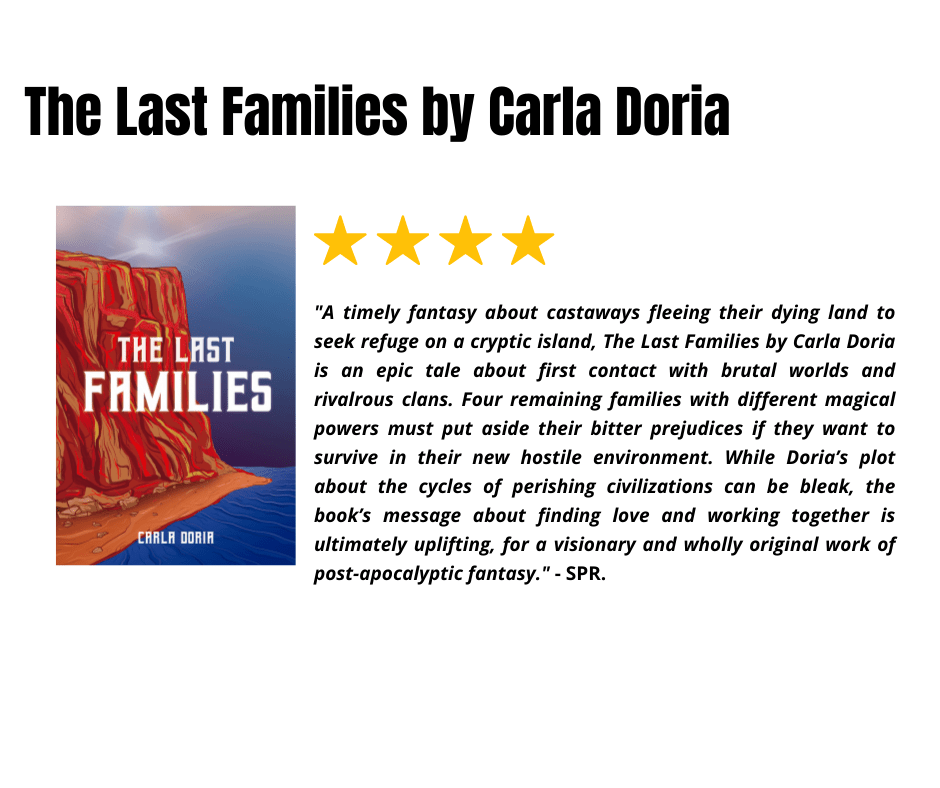
  • The Last Families by Carla Doria Review

    Getting this wonderful review is what makes my day.
    If you haven’t gotten your copy of The Last Families, please go to:

  • Choosing a Print on Demand/ebook distribution service- Part Three

    I never planned to have a third part for these series. You probably realized that I had Part one: Choosing a Print on Demand Service and Part Two: Choosing a Print on Demand service. And the result from both posts was choosing Lulu.com. The plan was that Lulu would be my chosen service for print books and also for ebook distribution. Of course, I wanted to keep it all in one single place. In the end, I had to withdraw my ebook from Lulu and choose another service. Let me tell you what happened:

    • I uploaded the Print book, ordered a proof and had it sent to me (that took me almost 6 weeks but that is not on Lulu’s side but the terrible shipping service to Bolivia, even when paying a more expensive one. It is not even the service to blame, but an ongoing issue with all shipping to Bolivia.)
    Photo by Karolina Grabowska on Pexels.com
    • I contacted Lulu support and asked: “Is there a way for me to plan a launch date?” Everything about book marketing is about having your launch date. You plan ARCs, reviews, etc for the launch date. The short answer from Lulu was: “No”. They give you a 2-4 estimate for ebooks and 4-7 weeks for printed books. That is the time that you have to wait until the book is on Amazon, Apple, Barnes & Noble, etc.
    • I contacted Lulu support and asked “Will I know when the book is listed on a service?” Short answer. “No”. We suggest googling your ISBN starting on week 2. THIS IS annoying. Imagine yourself googling your ISBN every day to know when the book is already listed somewhere.
    • While the printed proof was on the way to far-away Bolivia. I thought that it was time to upload the ebook. I was trying to time both of them given the estimate of weeks that I was given for each version.
    • While I still waited for the printed book, 4 weeks had already passed since I submitted the ebook AND it wasn’t on Amazon. It was everywhere, even platforms I didn’t they existed, but not on Amazon. And to be honest for an ebook, the Amazon kindle version is the most important for your book’s official launch. Even reviewers ask for your Amazon link.
    Photo by Enzo Muu00f1oz on Pexels.com
    • The printed book finally arrived and I can admit that quality was really good. I was happy with that. I approved the book the same day. And guess what? the printed book was already on distribution and on Amazon the very next day. What was going on then with the ebook? Why wasn’t it listed? It was already one month after its submission.
    • I contacted Lulu and they gave an explanation of them having submitted the book to Amazon and not knowing why it wasn’t listed. Great answer! Sigh… They told me to wait a bit more.
    • I waited 2 weeks more. Meanwhile, the printed book was already online, and worst of all, it had been launched with the date when I ordered the proof, 2 months ago. September. That didn’t look good. I was telling people and reviewers that I was waiting for the books to be listed to announce the launching date and the printed book was already there since September 🙁
    • This is the part when I got annoyed with Lulu. I contacted them at least 3 times more. I got autoreplies! from people not available, going on vacation, etc. Horrible customer support. That is when I thought. Do I have to use the same service for print and ebook? Therefore, I went back to my list of considered services and I knew there was one that had strucked me with good support service but was only doing digital: Draft2Digital.
    Photo by Perfecto Capucine on Pexels.com
    • I decided I was going nowhere with Lulu. I thought that at this point I couldn’t wait forever for Amazon to list the ebook. I decided to retire my ebook from Lulu. I submitted it with Draft2Digital and:
    • It turns out that Draft2Digital helps you get a launch date. They tell you when your book is approved and listed with a platform. They tell you everything. They are good with customer service. It took around 3-4 days to have my ebook finally listed with Amazon. If they had the printed service, I would definitely move over with them. Another advantage is that you can select to be paid with PayPal and Payoneer (this is the only option that lets me cash out the money.) Besides their take on sales is lower than Lulu. I already knew this. Lulu’s take is 20% (aside from Global distribution fees) and Draft2Digital is 10%.
    • Funny fact to finish the story? After I retired my ebook from Lulu. They had the nerve to reply to my emails and say they were so sorry about this issue. It turns out they had been having problems with their platform and submissions to Amazon for many ebooks. I work with customer service. It would have made sense to mention that to their customers that in first place.

    Conclusion: Why did I think that I had to use one single service for both versions? The ebook and the printed versions are considered different versions because they have their own ISBN. There is no rule anywhere that says that you have to use the same platform for both versions. For any new writers out there, looking into self-publishing, I hope this post helps with an additional option: publishing different versions with different services. What works better for you.

    And in the meantime, if you haven’t checked my latest Editorial Review from SPR:

    https://www.selfpublishingreview.com/editorial-reviews/

    Do you want to get a copy of The Last Families?


    You can also buy it at the following platforms:

    I would greatly appreciate leaving a review if you decide to buy it.

    Do you want to check out the book’s website?

  • Book Release “The Last Families”

    I’m happy to announce the official release of my first fantasy novel “The Last Families”:

  • Understanding ARC and getting reviews

    When I decided I was ready to publish my book, I never thought that getting reviews for the book’s launch would be that difficult. Everywhere you look for information, videos, and tutorials on what to do to launch your book, you get advice about getting early reviewers as part of your book launch “team”. We are not talking about reviews from your friend and family, but reviewers who do book reviews, have a platform of their own (a blog or social media), and can provide their honest review and have it on their platforms. The idea is to have some people talking about your work by the time the book gets launched.

    There are many services that help you with this, meaning that you subscribe to get access to their reviewer database, but they don’t promise reviews. Then there is a more organic way to do this, i.e reaching bloggers or people with a platform and asking them to review your book.

    Photo by cottonbro on Pexels.com

    For any people out there in the process of self-publishing a book, I would like to tell you about my process and struggles with getting reviewers:

    • It won’t be easy. I thought that getting an agent for traditional publishing was difficult. No, getting reviewers is more difficult.
    • You can start requesting reviews before publishing your book. This is a review on your ARC (Advanced Reader Copy). There are services like Booksprout (with accessible prices), NetGalley (expensive) and others. My book is currently submitted in Booksprout in this link. I haven’t received any requests yet.
    • You can also use similar services like Reedsy Discovery to access their reviewers database and get a review by your launch day. The idea is to submit your review request on this platform around 1 week before the launch. It is paid service as well. One thing to take into account that these services clarify that the payment is only for access to their database but reviewers are not paid. Paid reviewers is a no, not only in Amazon, but also ethically.
    • Then there is the organic way to do this: search for book bloggers and social media people that do book reviews. This is like jumping into a sea of never-ending information. I was lucky enough to find this Reedsy list of Book Bloggers where you can find more than 200 bloggers. I went through each blog, read the review policy (where you can see if the blogger takes self-published books, if they read your genre, if they need a printed copy, etc) and emailed around 50 bloggers that read Fantasy and were open to reviewing books at the moment. Like Literry agents, book bloggers are sometimes open and sometimes not. I’ve starting getting some replies already that they are sorry but they won’t be able to review my book. Sigh…
    Photo by cottonbro on Pexels.com
    • Then there is Blog Tours. I learned about them only a couple of months ago when I started this self-publishing project. Usually book bloggers with a high outreach will have their own people (followers) that are part of their network and will get them to either do a review on your book, publish an excerpt about it, do an author interview, or simply upload the book cover and info in their Bookstagram (more about this on a later post) and other social media. These tours are paid and are not very cheap. They usually last in between 1 to 2 weeks, and their packages will offer in between 7 to 15 book bloggers to talk about your book in the time you selected. I’m actually considering the cheapest ones and still thinking of its the advantages. If anybody out there has done a blog tour, please let me know your experience. Blog tours are not specifically reviews, but some participants might choose to do a review on your book, that is why I included it in this post.

    In a next post, I will broaden on other book promotions that I found out there from $5 to the hundreds $$.

    Has anybody had experience with book reviewers? Is there any other tip that I’m missing?

  • Receiving the first copy of my book

    It took around one month for a copy of my printed book to get here. If you remember my previous post where I made a reflection of who I chose a Print on Demand service, you will remember that Lulu was the chosen one.

    In order to start distributing paperback copies and have your book listed under services like Amazon, Barnes & Nobles, Kobo, Google Books, and others, they send you a printed copy of your book for you to approve it. It makes sense, especially when you design the interior and take care of all the formatting needed for the book. You want to make sure that the book is printing well, and the format and design you uploaded are showing correctly before it is distributed to other websites.

    So after uploading my PDF (with all the needed formatting that I had to learn) and uploading a cover file (which was designed by a friend), the paperback copy was ready and therefore, I ordered a copy for “approval”.

    Given my bad experience with carriers like DHL and the terrible Bolivian regular mail, I decided to use a service called Aeropost. It is a service for most Latin American countries. You send your order to an address in Miami (meaning that the shipping inside the US is quite fast and not expensive), and from there they consolidate their packages and bring them over to Bolivia. When I talked with the Aeropost sales representative, they said it would take the most 10 days. It was a decent waiting time for me. I paid online $14, which wasn’t that bad compared to what DHL would charge you, and waited.

    After ten days, I could still see my package not having left Miami. After calls to Aeropost, it turned out that they were using a very low-key military airline to bring the packages over and that airline had stopped their flights. They were trying to negotiate shipping with a new airline. Short story, it took one month for the package to get there. Regular mail would have taken almost the same, around 6 weeks. That delayed all the plans that I had to release the book in November. The book got here at the beginning of this week and I just approved the printed copy on Lulu’s website. Now there is a wait time of 8 weeks, after approval, for your book to be listed on other services. At this pace, I only hope the book will be out there this year (crossing fingers it will be for Christmas).

    I thought it would be fun to record myself at the moment of receiving my book, unpackaging it, and seeing it for the first time. I didn’t know if I was going to use that video for social media or not. Maybe I really didn’t like the book, and my reaction was terrible, but I decided to do it anyway. Anyway, it would be a good memory to recall: that time when I first saw a copy of my first book. The book looks quite good. The cover is awesome and printing has gone very well. All formatting looks top-notch and I feel relieved.

    I thought it would be a good idea to embed this Instagram video here: (if you are not seeing the video play, please click on the image)

    Now, let’s cross fingers I can announce the book’s release for this year.