I had a couple of beta readers for my first book “The Last Families” and I regret that I didn’t get more. Not necessarily because the book needed a lot of feedback, but because they’re extremely valuable. And when you’re about to launch a book- especially if it’s self-published- you need a team of supporters behind you. Beta readers will be familiar with your book and will be often willing to help you by leaving reviews and spreading your book’s launch on their social media.
But like me, I was afraid to have people reading my book- afraid of the feedback, afraid of having someone tell me “your work sucks” or something like that. This time though, I’m open to as much beta readers as possible, as I explain in this post for my newest manuscript. I’ve already received some feedback on the “When the World Disappears”, and it’s been extremely valuable. Thanks to it, I managed to correct and make significant improvements to the manuscript, the characters, and the story.
During this process, I participated of a beta reading swap as well: you read mine and I read yours. In one particular case with a specific writer, I noticed how writers can sometimes be apprehensive to feedback. In this blog post, I’ll share with you what I observed and I’ll discuss what we must not do as writers when receiving feedback.
Beta reading feedback must be listened and considered. Do you have to change everything you’re told by the beta reader? No. But you should listen their feedback carefully and analyze it.
In this particular situation, I had a beta reading swap that turned out one of the most uncomfortable situations ever. We had to finish/cancel the deal even when she hadn’t even started reading my manuscript (I had read almost a third of hers.)
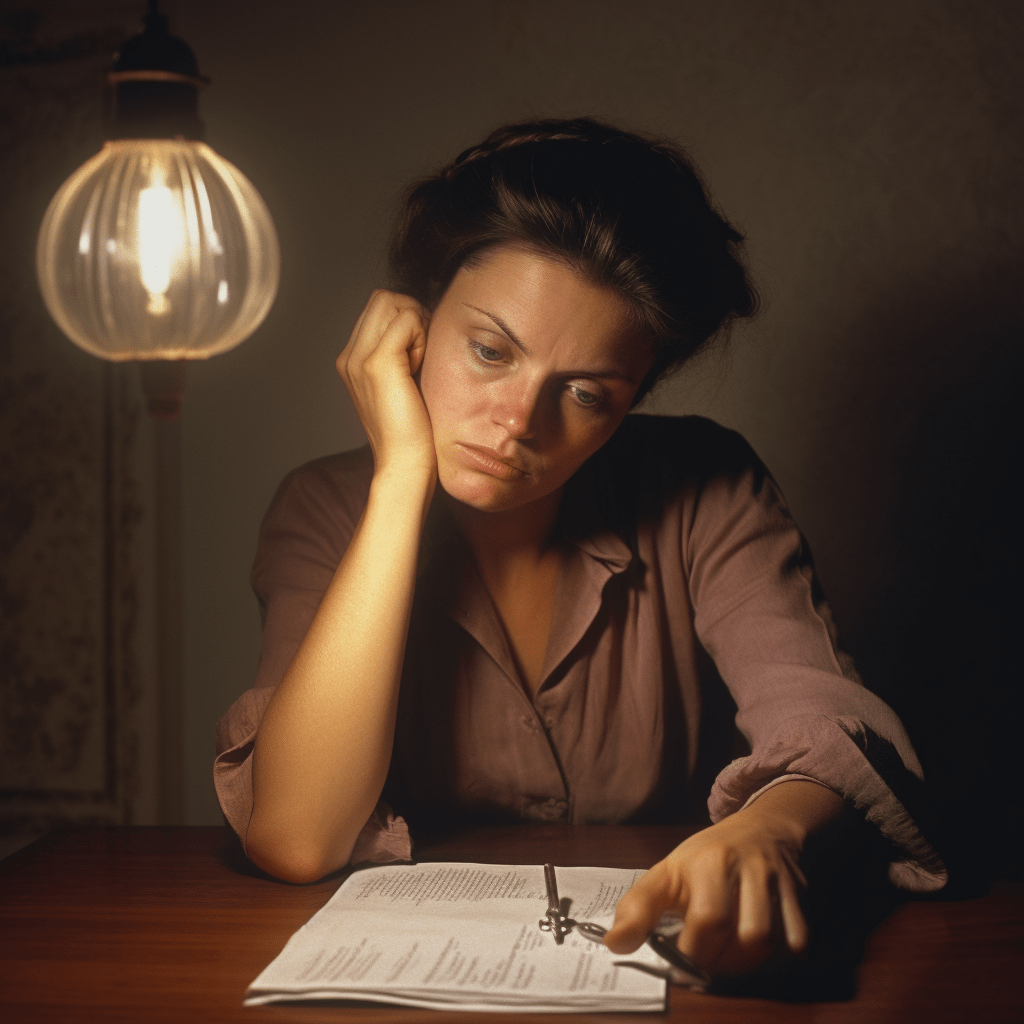
AI generated image
The feedback was given through a shared Google Doc, which meant that the writer and I could see the comments in real-time. From the moment I left my first comment in one paragraph, I got a counter-comment commenting on my feedback. It wasn’t that bad at the start, but then it got to a point where I could see the writer was unwilling to consider any of my suggestions. Though I don’t remember the specifics since that happened a few months ago, I’ve come up with some examples that are representative of that exchange:
Comment from Carla:
This is not clear. I suggest adding more details of why this character is reacting this way.
Reply from the writer:
Why is not clear? What details?
Comment from Carla:
It’s not clear why character is reacting this way. She’s a grown up person and her intents are not clear.
Reply from writer:
I don’t understand. Be more specific.
Another example
Comment from Carla:
The description is too vague. I would suggest adding more information about this location so readers can immerse themselves.
Reply from writer:
What is vague? What do you mean adding information so readers can inmerse themselves?
Last example
Comment from Carla:
Why does this character say that? It doesn’t sound like her.
Reply from writer:
It’s what she would say in this situation. Why wouldn’t it sound like her?
I have to say that I learned giving feedback from others who gave me feedback before. My first beta readers would usually approach their feedback in two ways:
The more detailed ones would highlight paragraphs and give me comments and observations.
Other general beta readers would send me a document outlining their general thoughts and their observations of what was not working.
As a beta reader myself, I decided to use the first approach, giving comments in a shared document. Until this specific writer, I had no issues. When I received feedback with inline comments on a shared document, I would assess them carefully. I didn’t agree with some of them, but if a comment pointed out that the reason of character X wasnt’t clear or that I needed to provide more context for situation B, I would go back to my text, analyze the issue, and try to improve where it was possible. If a comment told me that a piece of dialogue felt off, I would take into consideration and make adjustments where I could. There were a few times where I felt the dialogue couldn’t be changed, but I chose not to tell that to the person providing the feedback.
I’m not saying that you shouldn’t reply back to the beta reader and refute their observations, but if someone is giving you advice, LISTEN to it. The beta reader has left that comment to help you improve and not to debate it until someone wins.
This is how I see beta reading- what’s your take on it?
I’m proud to announce that my manuscript for my latest fiction novel is ready. Now, I’m beginning the publishing process. First, I’m pitching it to literary agents, and if I get no results in around four months, I will reconsider self-publishing.
Since, I’m not near the publishing date, I’m very open to beta readers in general. From my first publishing experience, I’ve learned that the more beta readers you get the better. So for anyone interested, the title is “When the World Disappears”. It’s a dystopian novel and here’s the blurb:
A virus has struck the earth again with a 90% mortality rate. As the population of the world succumbs to the virus and to mayhem, a vaccine that seems to be the only beacon of hope emerges thanks to the Red Velvet organization in the small Bolivian town of Costa Toro. However, the cure brings unforeseen side effects that will change the lives of the survivors of this small town.
Larissa has managed to hide from the virus and survive for almost 5 years with her younger brother Hugo. One day, she stumbles upon a mysterious message from someone claiming to have the solution to fix all things. In a world stripped of most of the internet as we know it and with few options to survive, Larissa can’t accept the new reality and wants a better future for Hugo. In her quest, she will meet other people her age and Adrian, who becomes more than just an ally.
But a misstep exposes her to the twisted new-order authorities of Costa Toro, in particular to Deborah and Governor Fuentes. Both with sinister ties to the Red Velvet organization, which seems to want to keep the status quo. The new order has also brought Adrian to the mercy of an evil punishment. Amidst saving her friend and escaping Deborah, will Larissa find the means to change her world? Who is this Red Velvet organization, and what is their relationship with the government of Costa Toro?
How does it sound? Would you read it?
If you’re interested in beta reading, let me know. I can do swap beta reading as well: you read my manuscript, I read yours.
I’ll be publishing some extracts and chapters as well in the next months.
AI has become a controversial topic among the community of writers.
We all know that chatGPT and similar tools that can pull up professionally written content. Chances are that most people working desktop jobs have used this tool at some extent. But what happens with writers?
If you tell chatGPT to write a piece of fiction portraying characters X and Y with a given topic, it will write one that could be quite passable. For many unscrupulous bogus writers, it will be enough to be published. Hence the uprise of AI-created books published on platforms like Amazon and similar. If you’ve read one of these books, chances are you deemed it rubbish.
My experience with reading AI fiction and AI non-fiction
Personally, I haven’t read AI fiction, as I’m very careful with the books that I acquire through online platforms. But I’ve come across with one or two non-fiction books, likely purchased at an average of 0.99 cents, promising to be the holy grail to learn subject X. If these non-fiction books had been written by a real person, chances are that twenty pages of content could have been told in one page, the most. They are overly repetitive, mostly make no point, and/or are filled with irrelevant content. No wonder the community of writers looks at the use of AI with disdain.
Using AI for editing
But I don’t. I’m starting to use AI to help my writing. But wait, don’t leave the post now if you’re a fellow writer. Let me clarify: I don’t use it to write. I use it to overcome grammar and sentence structure issues. In other words, I don’t ask chatGPT to write something for me. I do the job—I write first, and when the round of review comes and I come across a sentence structure I’m not happy about, I ask chatGPT “suggest improvement of this text ….”.
Do I replace my text with the AI suggestion? No, not at all. To be honest, I don’t use around 80% of the suggestions. ChatGPT is too repetitive and makes up information that is not relevant to my story at all. But in its suggestions, I find certain wordings and structures that are useful in around 20% of the times.
Telling when a text is AI written
If I were to ask chatGPT to do all the work and to write for me, only to review and adjust later to match my voice, it would be like rewriting it from scratch. I found out that whatever default style chatGPT uses, it has these characteristics:
And I tell the AI tool to improve it, chatGPT suggests:
Camila's brows knitted tightly, her frown deepening as she fixed her gaze on the dog. Her lips pressed into a thin line, and her eyes narrowed, reflecting a mix of confusion and unease. Something about the dog's behavior—or perhaps its presence—clearly unsettled her, and she couldn’t look away.
Text I copied from ChaGPT.
Clearly it’s not a bad piece of text, and sometimes writers who struggle with description might find the AI suggestions tempting. But can you imagine this type of prose in every single paragraph? It would be the most annoying reading ever.
Let’s analyze it deeply, sentence by sentence:
Camila's brows knitted tightly, her frown deepening as she fixed her gaze on the dog.
First sentence is good.
Her lips pressed into a thin line, and her eyes narrowed, reflecting a mix of confusion and unease.
The portion that says “reflecting a mix of confusion and unease” is a “telling” prose. There’s no need for these extra words. The description of the lips and the eyes are enough to reflect that she was feeling confusion and unease.
Something about the dog's behavior—or perhaps its presence—clearly unsettled her, and she couldn’t look away.
It’s an acceptable sentence. But how can AI tell this is actually happening in my story? Maybe Camila wants to look away. Maybe the dog broke a lamp and the staring is more related to scolding the dog rather than that “unsettling dog’s behavior”. This is where AI makes things up.
In summary, if I was looking to improve my sentence, I would probably take into account some words suggested in the first sentence—and that’s all. I would have discarded the rest. Trust me, there will be many instances where I will reject all of the AI’s suggestion.
I think it is. When we, writers, are in the second or third rounds of revision, sometimes we get stuck with some paragraphs that don’t sound right, even though they are grammatically correct. AI suggestions can help us get out of that situation and improve our work.
Do I use AI when working on the first draft of a manuscript? No—short answer.
For me, the first manuscript draft is your essence as a writer. Here’s where you tell your world about your characters, your story, and you’re writing style. At this stage, you explore your imagination and creativity. If AI does this for you, then you’re not a writer, in my opinion.
Conclusion
I hope this blog post is helpful to those writers who are VERY reluctant to using AI. Of course, this is a personal decision, but as a writer who struggles in the rounds of revision, I have to be honest and admit that I use chatGPT to help me unlock potential uses of the English language. I don’t feel shameful about that because I know that 100% of the characters, the story, and the writing voice are mine.
My fantasy book “The Last Families” is a dystopian story that has characters with supernatural powers. But is Fantasy the right genre?
Almost after 6 months of its release, I have come to this question. Shouldn’t I have properly defined the genre before releasing the book? I supposed I should’ve.
From the single instant, I began imagining and writing this fantastic world where these characters with talents/superpowers existed, I knew it had to be fantasy. Nothing of that exists or will exist in this world.
But as I got reviews, most of them quoted “The Last Families” as a dystopian post-apocalyptical story. It got me wondering.
According to Merriam-webster, a dystopia is:
an imagined world or society in which people lead wretched, dehumanized, fearful lives
The Last Families has something of that. It makes sense. It is dystopian because it talks about a future world with less than utopic circumstances. The characters are the last survivors of their world. They are looking for refuge and arrive at a place that is everything but hospitable. Of course, they are fearful as in the definition.
Is it post-apocalyptic? The definition of post-apocalyptic says:
existing or occurring after a catastrophically destructive disaster or apocalypse In a postapocalyptic world where nature has become just as violent as humanity
So yes, The Last Families definitely complies with this too. The story takes place after their land has been destroyed. We came to assume that these people are somehow future descendants of humans but with certain particularities. Therefore, we could say that this is a future that could somehow exist in the future? I would say overly farfetched.
Therefore it is a dystopia and a post-apocalyptic story. And it turns out that these two are subgenres of Science Fiction, and not of Fantasy. That is where I was surprised. Being a big reader of Science Fiction, I never thought of The Last Families as belonging to this genre, but somehow it has been categorized under it.
Now, there is “Science Fantasy”. A new genre. Thank god for new inventions. The definition is familiar:
Science fantasy is a hybrid genre within speculative fiction that simultaneously draws upon or combines tropes and elements from both science fiction and fantasy.
I think that is where my book fits better.
Unfortunately, like many new genres, you won’t find them listed anywhere. If you look for categories with a Print On Demand service, Listing sites, Literary Agents, and Book Reviewers, you will find Romance, Science Fiction, Mystery, Fantasy, Young Adult, and other “general” categories. New genres and Sub-genres are not included.
So, does this screw things for how I’ve been listing my book? I don’t think so. In fact, I’ll see it as a new opportunity. Until yesterday, the book was mainly targetting Fantasy categories and keywords. Now I’m targetting dystopian, post-apocalyptic, and science fantasy. Maybe a new refreshing audience to target.
What do you think? Should I still call it Fantasy?
You haven’t gotten your copy of The Last Families yet?
I never planned to have a third part for these series. You probably realized that I had Part one: Choosing a Print on Demand Service and Part Two: Choosing a Print on Demand service. And the result from both posts was choosing Lulu.com. The plan was that Lulu would be my chosen service for print books and also for ebook distribution. Of course, I wanted to keep it all in one single place. In the end, I had to withdraw my ebook from Lulu and choose another service. Let me tell you what happened:
I uploaded the Print book, ordered a proof and had it sent to me (that took me almost 6 weeks but that is not on Lulu’s side but the terrible shipping service to Bolivia, even when paying a more expensive one. It is not even the service to blame, but an ongoing issue with all shipping to Bolivia.)
I contacted Lulu support and asked: “Is there a way for me to plan a launch date?” Everything about book marketing is about having your launch date. You plan ARCs, reviews, etc for the launch date. The short answer from Lulu was: “No”. They give you a 2-4 estimate for ebooks and 4-7 weeks for printed books. That is the time that you have to wait until the book is on Amazon, Apple, Barnes & Noble, etc.
I contacted Lulu support and asked “Will I know when the book is listed on a service?” Short answer. “No”. We suggest googling your ISBN starting on week 2. THIS IS annoying. Imagine yourself googling your ISBN every day to know when the book is already listed somewhere.
While the printed proof was on the way to far-away Bolivia. I thought that it was time to upload the ebook. I was trying to time both of them given the estimate of weeks that I was given for each version.
While I still waited for the printed book, 4 weeks had already passed since I submitted the ebook AND it wasn’t on Amazon. It was everywhere, even platforms I didn’t they existed, but not on Amazon. And to be honest for an ebook, the Amazon kindle version is the most important for your book’s official launch. Even reviewers ask for your Amazon link.
The printed book finally arrived and I can admit that quality was really good. I was happy with that. I approved the book the same day. And guess what? the printed book was already on distribution and on Amazon the very next day. What was going on then with the ebook? Why wasn’t it listed? It was already one month after its submission.
I contacted Lulu and they gave an explanation of them having submitted the book to Amazon and not knowing why it wasn’t listed. Great answer! Sigh… They told me to wait a bit more.
I waited 2 weeks more. Meanwhile, the printed book was already online, and worst of all, it had been launched with the date when I ordered the proof, 2 months ago. September. That didn’t look good. I was telling people and reviewers that I was waiting for the books to be listed to announce the launching date and the printed book was already there since September 🙁
This is the part when I got annoyed with Lulu. I contacted them at least 3 times more. I got autoreplies! from people not available, going on vacation, etc. Horrible customer support. That is when I thought. Do I have to use the same service for print and ebook? Therefore, I went back to my list of considered services and I knew there was one that had strucked me with good support service but was only doing digital: Draft2Digital.
I decided I was going nowhere with Lulu. I thought that at this point I couldn’t wait forever for Amazon to list the ebook. I decided to retire my ebook from Lulu. I submitted it with Draft2Digital and:
It turns out that Draft2Digital helps you get a launch date. They tell you when your book is approved and listed with a platform. They tell you everything. They are good with customer service. It took around 3-4 days to have my ebook finally listed with Amazon. If they had the printed service, I would definitely move over with them. Another advantage is that you can select to be paid with PayPal and Payoneer (this is the only option that lets me cash out the money.) Besides their take on sales is lower than Lulu. I already knew this. Lulu’s take is 20% (aside from Global distribution fees) and Draft2Digital is 10%.
Funny fact to finish the story? After I retired my ebook from Lulu. They had the nerve to reply to my emails and say they were so sorry about this issue. It turns out they had been having problems with their platform and submissions to Amazon for many ebooks. I work with customer service. It would have made sense to mention that to their customers that in first place.
Conclusion: Why did I think that I had to use one single service for both versions? The ebook and the printed versions are considered different versions because they have their own ISBN. There is no rule anywhere that says that you have to use the same platform for both versions. For any new writers out there, looking into self-publishing, I hope this post helps with an additional option: publishing different versions with different services. What works better for you.
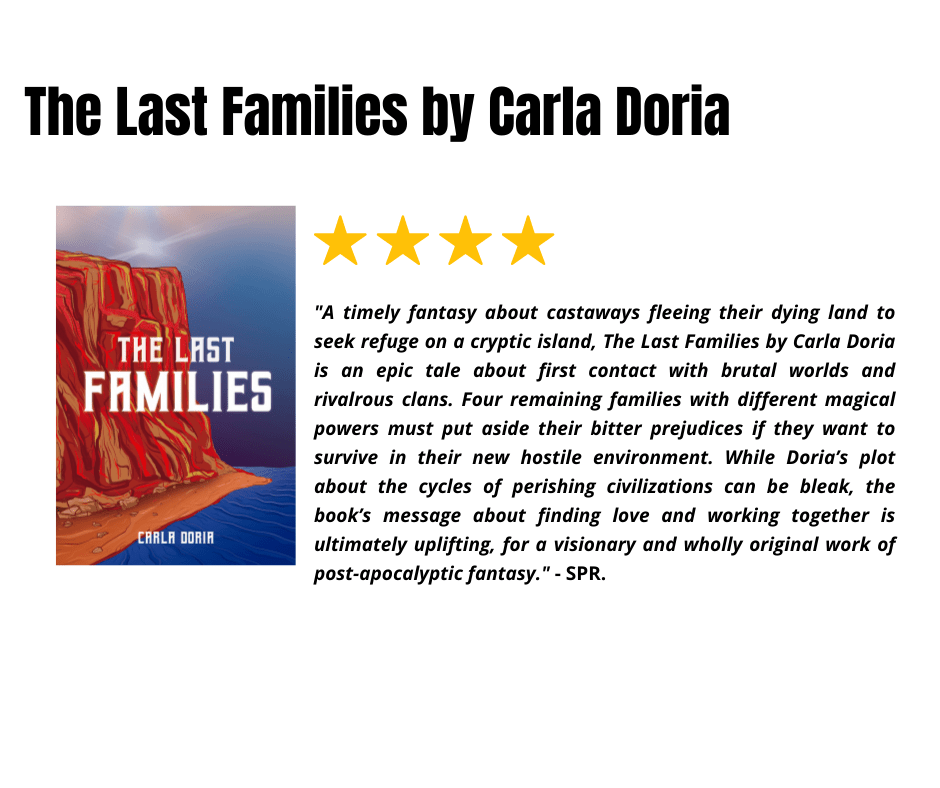
And in the meantime, if you haven’t checked my latest Editorial Review from SPR:
It took around one month for a copy of my printed book to get here. If you remembermy previous postwhere I made a reflection of who I chose a Print on Demand service, you will remember that Lulu was the chosen one.
In order to start distributing paperback copies and have your book listed under services like Amazon, Barnes & Nobles, Kobo, Google Books, and others, they send you a printed copy of your book for you to approve it. It makes sense, especially when you design the interior and take care of all the formatting needed for the book. You want to make sure that the book is printing well, and the format and design you uploaded are showing correctly before it is distributed to other websites.
So after uploading my PDF (with all the needed formatting that I had to learn) and uploading a cover file (which was designed by a friend), the paperback copy was ready and therefore, I ordered a copy for “approval”.
Given my bad experience with carriers like DHL and the terrible Bolivian regular mail, I decided to use a service called Aeropost. It is a service for most Latin American countries. You send your order to an address in Miami (meaning that the shipping inside the US is quite fast and not expensive), and from there they consolidate their packages and bring them over to Bolivia. When I talked with the Aeropost sales representative, they said it would take the most 10 days. It was a decent waiting time for me. I paid online $14, which wasn’t that bad compared to what DHL would charge you, and waited.
After ten days, I could still see my package not having left Miami. After calls to Aeropost, it turned out that they were using a very low-key military airline to bring the packages over and that airline had stopped their flights. They were trying to negotiate shipping with a new airline. Short story, it took one month for the package to get there. Regular mail would have taken almost the same, around 6 weeks. That delayed all the plans that I had to release the book in November. The book got here at the beginning of this week and I just approved the printed copy on Lulu’s website. Now there is a wait time of 8 weeks, after approval, for your book to be listed on other services. At this pace, I only hope the book will be out there this year (crossing fingers it will be for Christmas).
I thought it would be fun to record myself at the moment of receiving my book, unpackaging it, and seeing it for the first time. I didn’t know if I was going to use that video for social media or not. Maybe I really didn’t like the book, and my reaction was terrible, but I decided to do it anyway. Anyway, it would be a good memory to recall: that time when I first saw a copy of my first book. The book looks quite good. The cover is awesome and printing has gone very well. All formatting looks top-notch and I feel relieved.
I thought it would be a good idea to embed this Instagram video here: (if you are not seeing the video play, please click on the image)
When I started writing several years ago, it took me sometime to decide which was the genre that worked for me the best. I started with thrillers, thinking that it would be difficult to create a fantasy or science fiction world. I love reading thrillers, that can’t be questioned, but I also love reading other genres like fantasy.
I thought that developing characters and a story in a world that already existed would work for me better as a beginner writer. But setting a story in a current world is not easy. You still have to do research, know the place where it will take place, research about the people in this place, the language they use, etc. After a first manuscript that didn’t work well, I realized that I wasn’t that good at establishing a current environment, so I thought I would give it a try with fantasy.
But would I be imaginative enough to figure out a whole fictional world? Would I have the words and imagination for world building, aside from character building? I didn’t know. I doubted myself a lot, but I still started with a story that I had a long time in mind.
When I started writing “The Last Families”, I gave it a simple title “New World”. It was because I was writing about a new world and thought it would be better to name it like that than simply “Manuscript”. I started describing those fantasy landscapes that I had imagined before. It wasn’t that bad and I enjoyed the process. Some time later (a couple of years) here I’m with my first fantasy novel.
I’m not sure if fantasy is all I’m ever going to write but my next story is still in this genre. There is a mix of science fiction in some parts of The last Families and I’ll probably explore this genre a bit more in the future. Right now, I’m happy that I get to explore my imagination much better than when I was trying to adapt my stories to an existing world just because of writing comfort. I feel better challenging myself.
When I started working on my launch plan, the website was a no brainer. That is the only thing that I would be able to pull it out myself without hiring somebody else. I’m happy to admit that I really enjoyed the process and the website is ready.
For any other authors out there that might be seeking into setting up a website for their book, and you are not sure what content to include, after doing some research, this is the content that I included:
A Homepage that summarizes most of the website’s content, from the book’s release info, author, contact form, etc. The idea is that most people won’t navigate further than the homepage and won’t even click the navigation menus.
An About the Author page. This is a must in a book’s website. I included a short bio- the same that is placed in the back of the book’s cover. I have the belief that it has to include a good picture, people could want to meet/see the author.
A link to the Author’s blog, that means to this blog. I don’t think I’ll have a blog section in the book’s website. Maybe in the future. Although I’m not really sure what would I blog about. But in the meantime, I have this blog that has been running since 2015 with over a hundred of posts. So why not link to this blog? That is a good way to get more followers in “The Diaries of the Happy Writer”.
A Contact page where anybody can contact me. I’m mostly thinking of people who might be interested in an ARC (Advanced Read Copy) or something like that.
The controversial “Fanfiction” page which after some carefulconsideration in a previous post, I decided to give it a go. It’s not like I’m a world famous author and will get myself into suing readers for copyright issues. The more people that can read my book, the better, and I’m honored if someone ever thinks of writing fanfiction about it.
The Reviews page. Although, reviews are preferred in store sites like Amazon or Goodreads, it is still okay for me if people want to leave their review on site. The page will still include, of course, links to the retailers’ sites.
I’m pretty sure this content is not stone-fixed. While this adventure of self-publishing my book continues, I’m pretty sure that I will find myself re-doing certain things. I might need to add other sections to the website that I hadn’t thought before. A blog section could be needed to boost the SEO, for example. But at this stage, I’m happy to say that The Last Families’s website is ready. Please make sure to click the button and subscribe to get updates:
I finally have a cover for my first fantasy novel “The Last Families” and I’m extremely happy to reveal it:
Printed Version
Ebook version
The cliffs in the cover are inspired by the first opening paragraph of the “The Last Families”:
Blood climbed at least half a mile towards the sky. That was Yarisha’s first impression when she saw the crimson hue that covered the tallest cliffs she’d ever seen. The immense island above them resembled a piece of land floating on the water’s surface. Judging by the marks on the red cliffs, the water could have been higher once. Whatever mineral drenched the rocks, it painted them a deep red. This wasn’t the dreamiest place one would expect, but the families didn’t have anywhere else to go. Their own land had been destroyed.
Thanks to Pablo Rico for his great work on this cover.
The book launches soon in November. Subscribe to this blog to get more updates:
When I decided to self-publish my novel “The Last Families”, I knew there would be many things that I would have to handle myself. One of them was the book’s website. But what is a book’s website supposed to include? I was imagining the Cover, maybe the book’s synapsis and that was it. It would be a pretty simple website and I wasn’t sure how appealing it would be.
One of the things that I loved about fantasy stories is that you can find lots of fans’ illustrations online. I was thrilled by the idea and decided that I was going to work with a friend who happens to be an illustrator to get some visuals for not only the book’s website but also for future social media makerting. Otherwise, if I only had the cover as my single visual, that would not enough material to use when promoting the book.
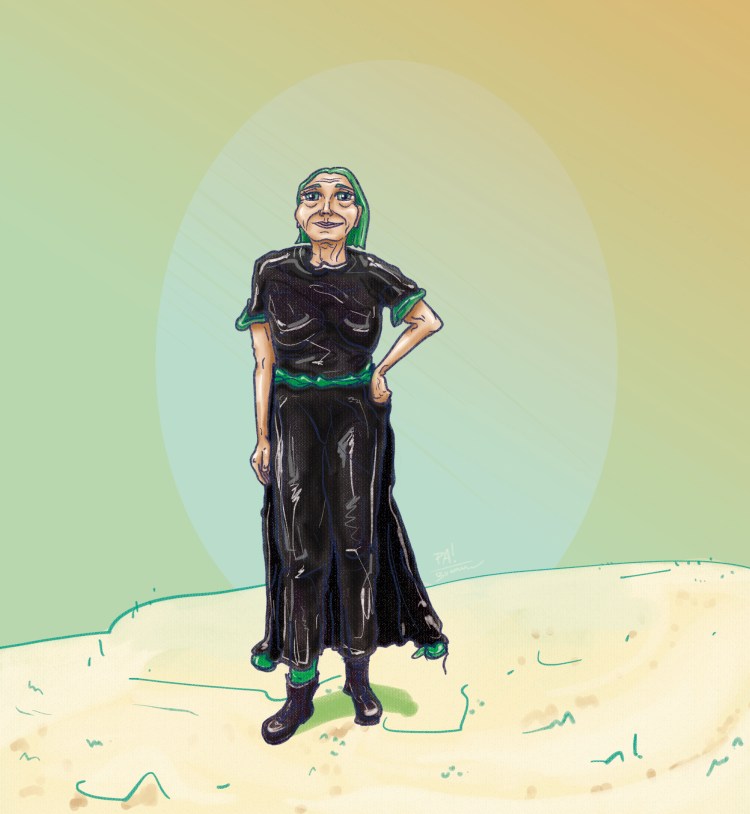
Therefore, based on the very particular specifics of my characters (purple, red, green hair, etc.) Let me introduce you to my characters’ illustrations that I will add to my novel’s website, including some brief excerpts from the novel that describe them.
Ian
Malakay
Yarisha
Ian: His short black hair with hard edges around his face made his expression tough. The man stepped down of his horse in one single jump. Small eyes framed a pointy nose, surrounded by very thin eyebrows. A huge, jagged scar drew a line down his throat. Ian wore fur boots and a coat, his attire’s color matching his skin tone.
Malakay: He was the tallest in the family, with shoulder-length hair, partially pulled back into a bun. He had little resemblance to his father; he had clearly inherited most of his mother’s traits. Malakay’s eyes were darker than usual. In some light, they even seemed black. Having acquired a certain tanned color, his skin wasn’t as white as the rest of his family.
Yarisha: The Verbaren family leader and the only mind-reader of her kind. According to Malakay, her blue eyes were appealing, and her red hair wasn’t as limp as the other Verbaren girls. She had soft curls that tangled with the wind, bringing some harmony to her face.
Mandely
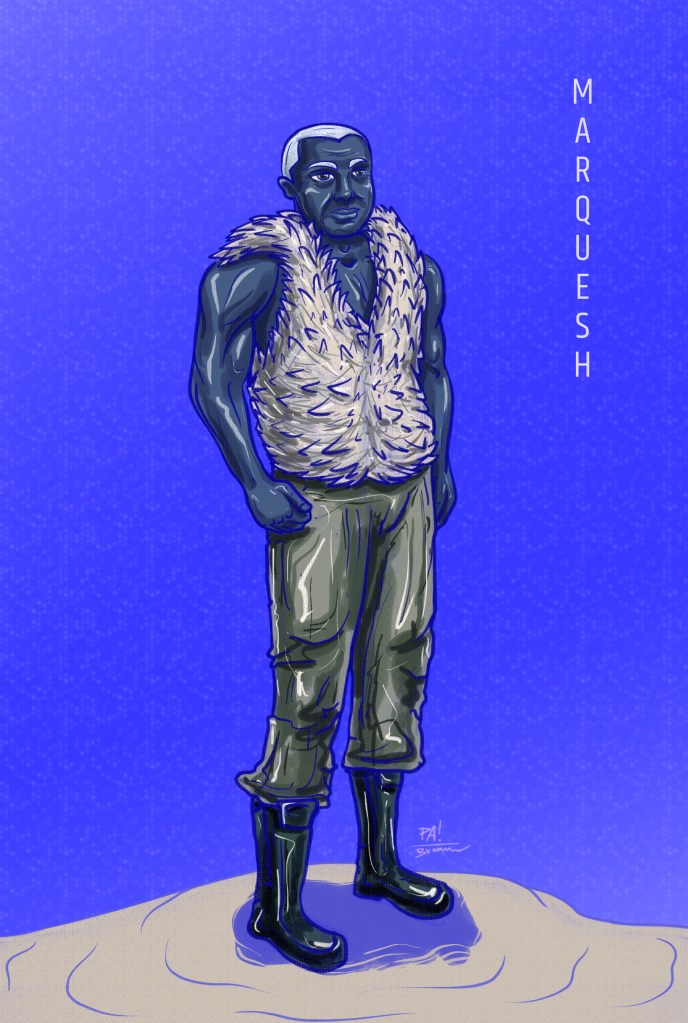
Marquesh
Palista
Mandely was probably in her late forties. She was mother to seven Ninfire children, and all had survived this trip. Mandely’s curly lilac hair differentiated her from her children. Her eyes were as big as two full moons. The purple in her eyes shone, making them look even bigger. Her apple-shaped face emphasized her cheeks.
Marquesh: The Drontas partriarch stepped in front of her field of vision. His silver-white hair contrasted with his black skin. A vest of white fur covered his big, muscled body. The Drontas’ talent was their physical strength.
Palista: The oldest woman and matriarch had the greenest eyes of the family, and it wasn’t a coincidence. The Kaptarish chose their leader based on the eyes’ brightness. It was said that the green color gave them the power to heat things up. Palista was the oldest person in the family and the oldest of all survivors reaching Gambir. Even though she was a grandmother of ten, she was still strong enough to lead her family.