I’m proud to announce that my manuscript for my latest fiction novel is ready. Now, I’m beginning the publishing process. First, I’m pitching it to literary agents, and if I get no results in around four months, I will reconsider self-publishing.
Since, I’m not near the publishing date, I’m very open to beta readers in general. From my first publishing experience, I’ve learned that the more beta readers you get the better. So for anyone interested, the title is “When the World Disappears”. It’s a dystopian novel and here’s the blurb:
A virus has struck the earth again with a 90% mortality rate. As the population of the world succumbs to the virus and to mayhem, a vaccine that seems to be the only beacon of hope emerges thanks to the Red Velvet organization in the small Bolivian town of Costa Toro. However, the cure brings unforeseen side effects that will change the lives of the survivors of this small town.
Larissa has managed to hide from the virus and survive for almost 5 years with her younger brother Hugo. One day, she stumbles upon a mysterious message from someone claiming to have the solution to fix all things. In a world stripped of most of the internet as we know it and with few options to survive, Larissa can’t accept the new reality and wants a better future for Hugo. In her quest, she will meet other people her age and Adrian, who becomes more than just an ally.
But a misstep exposes her to the twisted new-order authorities of Costa Toro, in particular to Deborah and Governor Fuentes. Both with sinister ties to the Red Velvet organization, which seems to want to keep the status quo. The new order has also brought Adrian to the mercy of an evil punishment. Amidst saving her friend and escaping Deborah, will Larissa find the means to change her world? Who is this Red Velvet organization, and what is their relationship with the government of Costa Toro?
How does it sound? Would you read it?
If you’re interested in beta reading, let me know. I can do swap beta reading as well: you read my manuscript, I read yours.
I’ll be publishing some extracts and chapters as well in the next months.
AI has become a controversial topic among the community of writers.
We all know that chatGPT and similar tools that can pull up professionally written content. Chances are that most people working desktop jobs have used this tool at some extent. But what happens with writers?
If you tell chatGPT to write a piece of fiction portraying characters X and Y with a given topic, it will write one that could be quite passable. For many unscrupulous bogus writers, it will be enough to be published. Hence the uprise of AI-created books published on platforms like Amazon and similar. If you’ve read one of these books, chances are you deemed it rubbish.
My experience with reading AI fiction and AI non-fiction
Personally, I haven’t read AI fiction, as I’m very careful with the books that I acquire through online platforms. But I’ve come across with one or two non-fiction books, likely purchased at an average of 0.99 cents, promising to be the holy grail to learn subject X. If these non-fiction books had been written by a real person, chances are that twenty pages of content could have been told in one page, the most. They are overly repetitive, mostly make no point, and/or are filled with irrelevant content. No wonder the community of writers looks at the use of AI with disdain.
Using AI for editing
But I don’t. I’m starting to use AI to help my writing. But wait, don’t leave the post now if you’re a fellow writer. Let me clarify: I don’t use it to write. I use it to overcome grammar and sentence structure issues. In other words, I don’t ask chatGPT to write something for me. I do the job—I write first, and when the round of review comes and I come across a sentence structure I’m not happy about, I ask chatGPT “suggest improvement of this text ….”.
Do I replace my text with the AI suggestion? No, not at all. To be honest, I don’t use around 80% of the suggestions. ChatGPT is too repetitive and makes up information that is not relevant to my story at all. But in its suggestions, I find certain wordings and structures that are useful in around 20% of the times.
Telling when a text is AI written
If I were to ask chatGPT to do all the work and to write for me, only to review and adjust later to match my voice, it would be like rewriting it from scratch. I found out that whatever default style chatGPT uses, it has these characteristics:
And I tell the AI tool to improve it, chatGPT suggests:
Camila's brows knitted tightly, her frown deepening as she fixed her gaze on the dog. Her lips pressed into a thin line, and her eyes narrowed, reflecting a mix of confusion and unease. Something about the dog's behavior—or perhaps its presence—clearly unsettled her, and she couldn’t look away.
Text I copied from ChaGPT.
Clearly it’s not a bad piece of text, and sometimes writers who struggle with description might find the AI suggestions tempting. But can you imagine this type of prose in every single paragraph? It would be the most annoying reading ever.
Let’s analyze it deeply, sentence by sentence:
Camila's brows knitted tightly, her frown deepening as she fixed her gaze on the dog.
First sentence is good.
Her lips pressed into a thin line, and her eyes narrowed, reflecting a mix of confusion and unease.
The portion that says “reflecting a mix of confusion and unease” is a “telling” prose. There’s no need for these extra words. The description of the lips and the eyes are enough to reflect that she was feeling confusion and unease.
Something about the dog's behavior—or perhaps its presence—clearly unsettled her, and she couldn’t look away.
It’s an acceptable sentence. But how can AI tell this is actually happening in my story? Maybe Camila wants to look away. Maybe the dog broke a lamp and the staring is more related to scolding the dog rather than that “unsettling dog’s behavior”. This is where AI makes things up.
In summary, if I was looking to improve my sentence, I would probably take into account some words suggested in the first sentence—and that’s all. I would have discarded the rest. Trust me, there will be many instances where I will reject all of the AI’s suggestion.
I think it is. When we, writers, are in the second or third rounds of revision, sometimes we get stuck with some paragraphs that don’t sound right, even though they are grammatically correct. AI suggestions can help us get out of that situation and improve our work.
Do I use AI when working on the first draft of a manuscript? No—short answer.
For me, the first manuscript draft is your essence as a writer. Here’s where you tell your world about your characters, your story, and you’re writing style. At this stage, you explore your imagination and creativity. If AI does this for you, then you’re not a writer, in my opinion.
Conclusion
I hope this blog post is helpful to those writers who are VERY reluctant to using AI. Of course, this is a personal decision, but as a writer who struggles in the rounds of revision, I have to be honest and admit that I use chatGPT to help me unlock potential uses of the English language. I don’t feel shameful about that because I know that 100% of the characters, the story, and the writing voice are mine.
I can’t believe it’s been almost two years since my last post. My day job was intensive, but other than that, I just felt I didn’t have anything interesting to say from a writer’s perspective. My first novel was published, and I entered a sort of writing hiatus. Then, last year, I started to write again. It felt good, but I still didn’t have anything compelling to share on my writing blog. Now, my circumstances have changed.
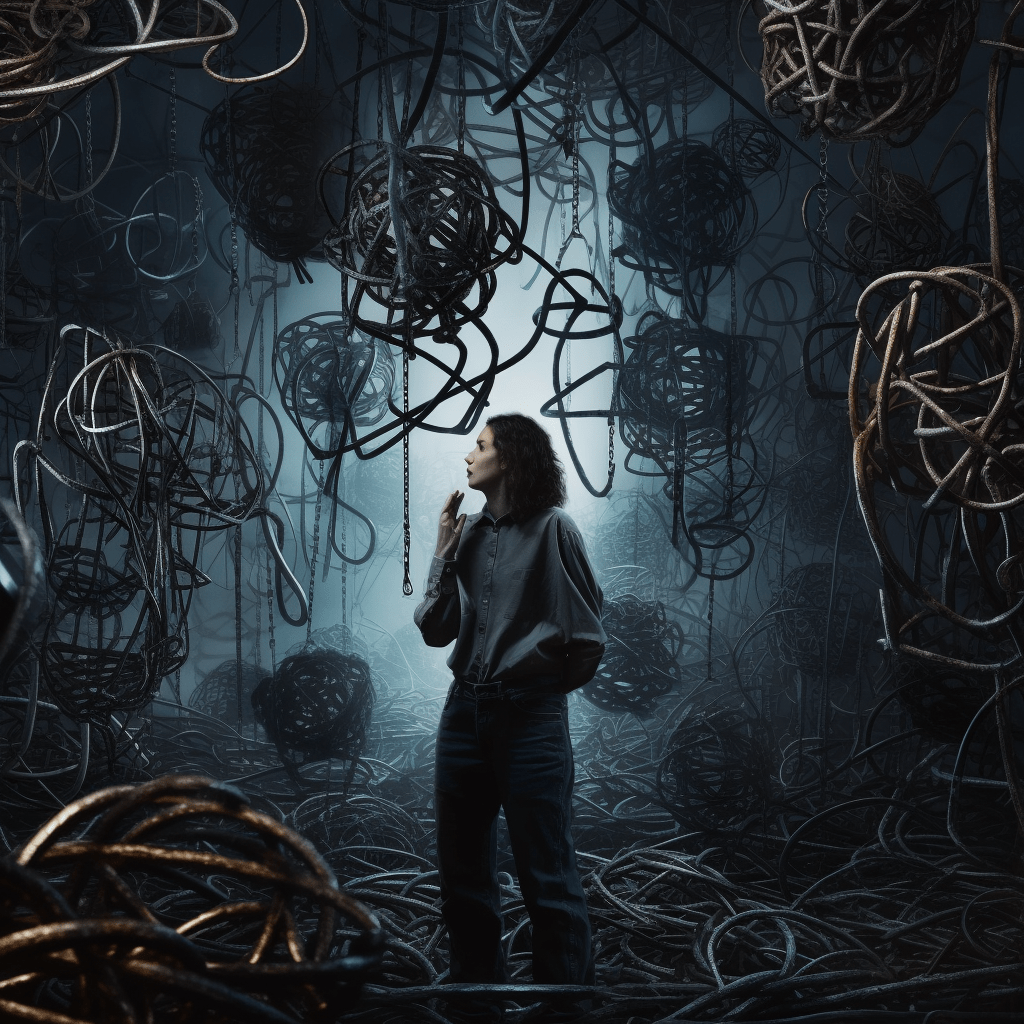
AI image generated by Midjourney
I’m in the process of transitioning from a very demanding job to finally having more time for my personal projects, one of which is writing. Last year, I started another fiction novel—a dystopian story. Different from The Last Families, I didn’t want this new novel to have multiple points of view and to be so complex. I wanted a simpler story, but a good one. I’ve already picked a name for this novel, although I’m very far from publishing it. I’m currently in the first round of beta readers and receiving so much good feedback. I’m in no hurry to publish this time. This novel is called “When the World Disappears,” and it is a dystopian story set in Bolivia, in a world following the aftermath of a pandemic (yes, I couldn’t help but get inspiration from Covid 😄 ). It has quite interesting twists. I will soon give more details.
This writing cycle has been different. Although I’ve only published one book, I’ve learned a great deal from the process of writing and self-publishing The Last Families. These are some of the lessons:
Fantasy, and especially high fantasy, can be hard to achieve. If this is your genre, I recommend simplifying the characters and the plot because the world-building of high fantasy is very complex already. While some, like Tolkien, have achieved this art, he devoted most of his life to endless manuscripts that his son then had a hard time compiling. As someone without any descendants, I don’t have the luxury of relying on future generations for compilations. Next time I choose to write fantasy, I’ll aim for a simpler plot.
AI image generated by Midjourney
Multiple points of view are hard—very hard. The only way to achieve them is to analyze each character deeply and be crazy enough (in a good manner) to jump from one character’s head to the other. One of the best pieces of feedback that I got from The Last Families was that I’ve managed to achieve good character development in spite of the multiple points of view, but it was so difficult that I’m not looking to revisit this approach in at least a decade.
Get beta readers very soon, and as many as possible. As a first-time writer, I felt very protective of my first novel and very insecure about my writing. Therefore, I delayed sharing it until I had meticulously reviewed it at least a dozen times, thus the long time it took to publish it. When I got a few beta readers—only two to be precise—I was desperate to have my novel out in the world, so I changed very little based on their feedback and continued with the publication process. Now, with my latest manuscript, I’m already in my fifth beta reader at an earlier stage. I’m now very open to change and feedback. With more beta readers, I’m also assembling a team of people who will be able to support me during the book launch.
Your plot doesn’t need an abundance of twists or complexity. This new novel is a shorter, nicer story with some surprising twists, but not so complex that I can’t describe it. When I pitched The Last Families to publishing agents, it was so hard to articulate a pitch letter. I couldn’t summarize the multiple points of view and the plot in 2-3 paragraphs. It was simply too hard. When the concept is so confusing, it’s hard to sell the idea. I didn’t like it when people asked me what my novel was about because it was too difficult to explain. Now with “When the World Disappears,” I can easily describe it, and I feel it’s easier to sell it not only to agents but also to readers. It’s far simpler to promote a work when the purpose and vision are clear.
AI image generated by Midjourney
These are just a handful of the lessons I learned with The Last Families. I don’t regret the process in this book, though. I still love my first fantasy book, and I’m planning to get a second edition and a Spanish translation later this year. But I’m determined to approach things differently this time, and I’m overly excited.
My fantasy book “The Last Families” is a dystopian story that has characters with supernatural powers. But is Fantasy the right genre?
Almost after 6 months of its release, I have come to this question. Shouldn’t I have properly defined the genre before releasing the book? I supposed I should’ve.
From the single instant, I began imagining and writing this fantastic world where these characters with talents/superpowers existed, I knew it had to be fantasy. Nothing of that exists or will exist in this world.
But as I got reviews, most of them quoted “The Last Families” as a dystopian post-apocalyptical story. It got me wondering.
According to Merriam-webster, a dystopia is:
an imagined world or society in which people lead wretched, dehumanized, fearful lives
The Last Families has something of that. It makes sense. It is dystopian because it talks about a future world with less than utopic circumstances. The characters are the last survivors of their world. They are looking for refuge and arrive at a place that is everything but hospitable. Of course, they are fearful as in the definition.
Is it post-apocalyptic? The definition of post-apocalyptic says:
existing or occurring after a catastrophically destructive disaster or apocalypse In a postapocalyptic world where nature has become just as violent as humanity
So yes, The Last Families definitely complies with this too. The story takes place after their land has been destroyed. We came to assume that these people are somehow future descendants of humans but with certain particularities. Therefore, we could say that this is a future that could somehow exist in the future? I would say overly farfetched.
Therefore it is a dystopia and a post-apocalyptic story. And it turns out that these two are subgenres of Science Fiction, and not of Fantasy. That is where I was surprised. Being a big reader of Science Fiction, I never thought of The Last Families as belonging to this genre, but somehow it has been categorized under it.
Now, there is “Science Fantasy”. A new genre. Thank god for new inventions. The definition is familiar:
Science fantasy is a hybrid genre within speculative fiction that simultaneously draws upon or combines tropes and elements from both science fiction and fantasy.
I think that is where my book fits better.
Unfortunately, like many new genres, you won’t find them listed anywhere. If you look for categories with a Print On Demand service, Listing sites, Literary Agents, and Book Reviewers, you will find Romance, Science Fiction, Mystery, Fantasy, Young Adult, and other “general” categories. New genres and Sub-genres are not included.
So, does this screw things for how I’ve been listing my book? I don’t think so. In fact, I’ll see it as a new opportunity. Until yesterday, the book was mainly targetting Fantasy categories and keywords. Now I’m targetting dystopian, post-apocalyptic, and science fantasy. Maybe a new refreshing audience to target.
What do you think? Should I still call it Fantasy?
You haven’t gotten your copy of The Last Families yet?
When I decided I was ready to publish my book, I never thought that getting reviews for the book’s launch would be that difficult. Everywhere you look for information, videos, and tutorials on what to do to launch your book, you get advice about getting early reviewers as part of your book launch “team”. We are not talking about reviews from your friend and family, but reviewers who do book reviews, have a platform of their own (a blog or social media), and can provide their honest review and have it on their platforms. The idea is to have some people talking about your work by the time the book gets launched.
There are many services that help you with this, meaning that you subscribe to get access to their reviewer database, but they don’t promise reviews. Then there is a more organic way to do this, i.e reaching bloggers or people with a platform and asking them to review your book.
For any people out there in the process of self-publishing a book, I would like to tell you about my process and struggles with getting reviewers:
It won’t be easy. I thought that getting an agent for traditional publishing was difficult. No, getting reviewers is more difficult.
You can start requesting reviews before publishing your book. This is a review on your ARC (Advanced Reader Copy). There are services like Booksprout(with accessible prices), NetGalley(expensive) and others. My book is currently submitted in Booksprout in this link. I haven’t received any requests yet.
You can also use similar services like Reedsy Discovery to access their reviewers database and get a review by your launch day. The idea is to submit your review request on this platform around 1 week before the launch. It is paid service as well. One thing to take into account that these services clarify that the payment is only for access to their database but reviewers are not paid. Paid reviewers is a no, not only in Amazon, but also ethically.
Then there is the organic way to do this: search for book bloggers and social media people that do book reviews. This is like jumping into a sea of never-ending information. I was lucky enough to find thisReedsy list of Book Bloggerswhere you can find more than 200 bloggers. I went through each blog, read the review policy (where you can see if the blogger takes self-published books, if they read your genre, if they need a printed copy, etc) and emailed around 50 bloggers that read Fantasy and were open to reviewing books at the moment. Like Literry agents, book bloggers are sometimes open and sometimes not. I’ve starting getting some replies already that they are sorry but they won’t be able to review my book. Sigh…
Then there is Blog Tours. I learned about them only a couple of months ago when I started this self-publishing project. Usually book bloggers with a high outreach will have their own people (followers) that are part of their network and will get them to either do a review on your book, publish an excerpt about it, do an author interview, or simply upload the book cover and info in their Bookstagram (more about this on a later post) and other social media. These tours are paid and are not very cheap. They usually last in between 1 to 2 weeks, and their packages will offer in between 7 to 15 book bloggers to talk about your book in the time you selected. I’m actually considering the cheapest ones and still thinking of its the advantages. If anybody out there has done a blog tour, please let me know your experience. Blog tours are not specifically reviews, but some participants might choose to do a review on your book, that is why I included it in this post.
In a next post, I will broaden on other book promotions that I found out there from $5 to the hundreds $$.
Has anybody had experience with book reviewers? Is there any other tip that I’m missing?
When I started writing several years ago, it took me sometime to decide which was the genre that worked for me the best. I started with thrillers, thinking that it would be difficult to create a fantasy or science fiction world. I love reading thrillers, that can’t be questioned, but I also love reading other genres like fantasy.
I thought that developing characters and a story in a world that already existed would work for me better as a beginner writer. But setting a story in a current world is not easy. You still have to do research, know the place where it will take place, research about the people in this place, the language they use, etc. After a first manuscript that didn’t work well, I realized that I wasn’t that good at establishing a current environment, so I thought I would give it a try with fantasy.
But would I be imaginative enough to figure out a whole fictional world? Would I have the words and imagination for world building, aside from character building? I didn’t know. I doubted myself a lot, but I still started with a story that I had a long time in mind.
When I started writing “The Last Families”, I gave it a simple title “New World”. It was because I was writing about a new world and thought it would be better to name it like that than simply “Manuscript”. I started describing those fantasy landscapes that I had imagined before. It wasn’t that bad and I enjoyed the process. Some time later (a couple of years) here I’m with my first fantasy novel.
I’m not sure if fantasy is all I’m ever going to write but my next story is still in this genre. There is a mix of science fiction in some parts of The last Families and I’ll probably explore this genre a bit more in the future. Right now, I’m happy that I get to explore my imagination much better than when I was trying to adapt my stories to an existing world just because of writing comfort. I feel better challenging myself.
The fact that a story has fantasy in it doesn’t mean that its whole world is made up and not related to current topics related to our own world. But if it wasn’t because I had to write a pitch, a synopsis, and disclaimers for this book, I wouldn’t have thought of the harsh underlying topics in the story:
End of the world /post-apocalyptic. Even though The Last Families happens in a fictional world, there is a background and time to the story. African, the last continent left on Earth, refers to a world that is far in the future, after the other continents have become lost somehow. The Last Families characters are still escaping from this last continent that is now facing its destruction.
Skin color/race as a factor to survive – Without going too much into details and telling part of the story here, the new place where the families have arrived, Gambir, has extreme circumstances that make that some people with certain skin color have better chances to survive.
Superiority of some families – Some families, like the Ninfires, believe they are superior than others. The idea of a group of people superior to other is still current relevant issue, no matter in which country we are located.
Misogyny – This is of course a characteristic that belongs to a villain, Ian, and even though this is a fictional world, unfortunately it can still be present.
There are still other harsh topics in “The Last Families” but that are better discovered during the story. Of course, this doesn’t mean that the story is only dark, it is also a story of love, leadership, tolerance, sacrifice and compassion.
When I decided to self-publish my novel “The Last Families”, I knew there would be many things that I would have to handle myself. One of them was the book’s website. But what is a book’s website supposed to include? I was imagining the Cover, maybe the book’s synapsis and that was it. It would be a pretty simple website and I wasn’t sure how appealing it would be.
One of the things that I loved about fantasy stories is that you can find lots of fans’ illustrations online. I was thrilled by the idea and decided that I was going to work with a friend who happens to be an illustrator to get some visuals for not only the book’s website but also for future social media makerting. Otherwise, if I only had the cover as my single visual, that would not enough material to use when promoting the book.
Therefore, based on the very particular specifics of my characters (purple, red, green hair, etc.) Let me introduce you to my characters’ illustrations that I will add to my novel’s website, including some brief excerpts from the novel that describe them.
Ian
Malakay
Yarisha
Ian: His short black hair with hard edges around his face made his expression tough. The man stepped down of his horse in one single jump. Small eyes framed a pointy nose, surrounded by very thin eyebrows. A huge, jagged scar drew a line down his throat. Ian wore fur boots and a coat, his attire’s color matching his skin tone.
Malakay: He was the tallest in the family, with shoulder-length hair, partially pulled back into a bun. He had little resemblance to his father; he had clearly inherited most of his mother’s traits. Malakay’s eyes were darker than usual. In some light, they even seemed black. Having acquired a certain tanned color, his skin wasn’t as white as the rest of his family.
Yarisha: The Verbaren family leader and the only mind-reader of her kind. According to Malakay, her blue eyes were appealing, and her red hair wasn’t as limp as the other Verbaren girls. She had soft curls that tangled with the wind, bringing some harmony to her face.
Mandely
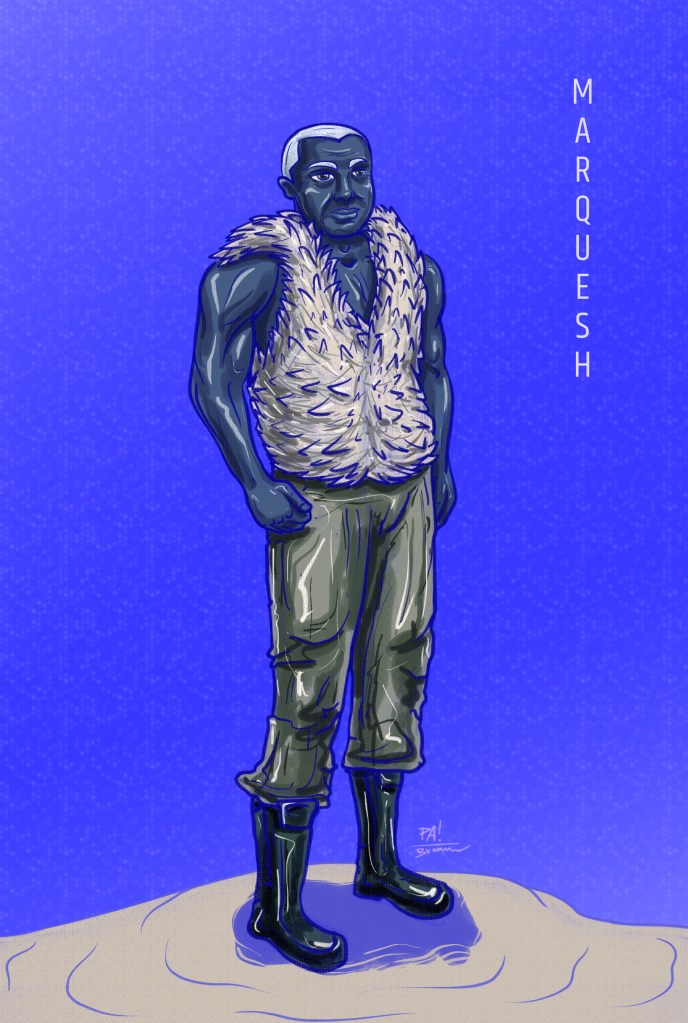
Marquesh
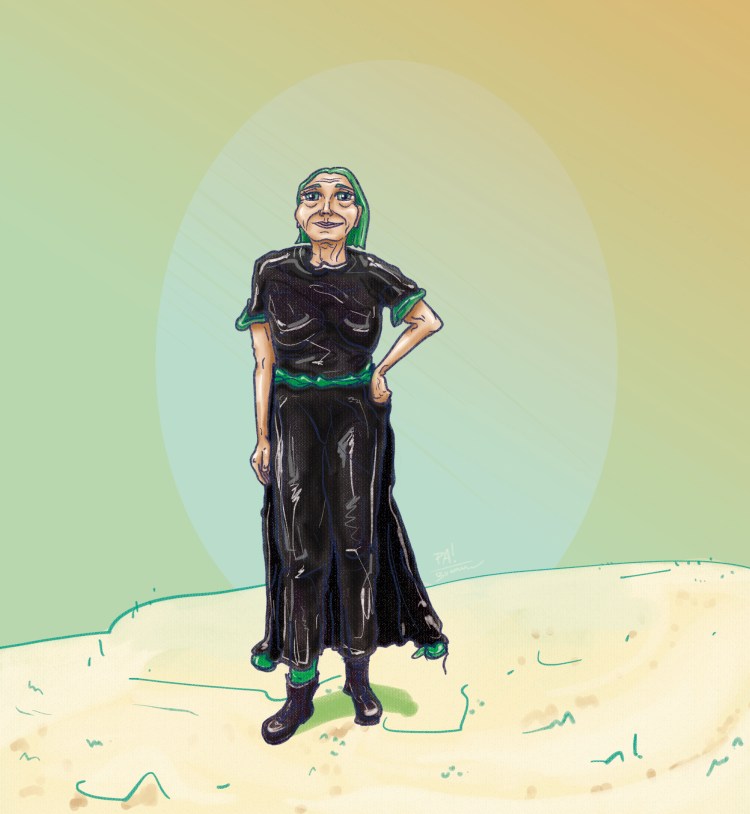
Palista
Mandely was probably in her late forties. She was mother to seven Ninfire children, and all had survived this trip. Mandely’s curly lilac hair differentiated her from her children. Her eyes were as big as two full moons. The purple in her eyes shone, making them look even bigger. Her apple-shaped face emphasized her cheeks.
Marquesh: The Drontas partriarch stepped in front of her field of vision. His silver-white hair contrasted with his black skin. A vest of white fur covered his big, muscled body. The Drontas’ talent was their physical strength.
Palista: The oldest woman and matriarch had the greenest eyes of the family, and it wasn’t a coincidence. The Kaptarish chose their leader based on the eyes’ brightness. It was said that the green color gave them the power to heat things up. Palista was the oldest person in the family and the oldest of all survivors reaching Gambir. Even though she was a grandmother of ten, she was still strong enough to lead her family.
As I submerge myself in this world of querying agents and receiving rejections, I started to take it as part of the common writing process. I no longer feel bad for the rejections coming from literary agent’s, in fact, I think they are making me stronger and more resilient.
In the meantime, I’ve also started to experiment with different query letters, manuscript summaries, and even decided to change my first chapter. I feel happy on the latter. I was never happy with having a prologue. For some reason, I thought my story really needed that prologue. However, once I decided to challenge this idea, I put my hands on re-writing the first chapter, integrating in it the prologue. It worked so well that I couldn’t believe it! I regretted sending queries to agents that had to go through my prologue (when they requested the first chapters or pages in the query letter). But well…sigh… one learns from these mistakes. It is not like I’m an expert or a published author.
I also took on revamping my query letter and summary – for those that request it. From the beginning, I knew they weren’t the best possible and I attributed this to my story being so complex that I couldn’t describe it in a couple of paragraphs, but I later discovered they were totally improvable and I twitched them a bit until I felt prouder of them.
I’m still going through my list of agents I want to query to. I’m not doing them all at once, neither one by one. But if the rejection trend is here to stay, then I’ll start pondering about self-publishing, which is not that bad according to what I heard. My only worry is that traditional publishing helps you get inside bookshops which is what I always wanted. It is not that I don’t trust the digital channels, and don’t see the potential in it, but there is a sweet spot in my heart where I want to see my book in a shelf in a bookshop. Who knows how things turn around. I’ve witnessed quite amazing events happening in my life.
In the meantime, if anybody is out there in the process of querying, writing query letters, preparing summaries, trust your instincts and make sure you are really proud of them.
There comes a point in time when you realize that the manuscript is ready to go out there. Or at least you want to believe that. My fantasy manuscript is ready and I’ve already started seeing publishing options (I’ll check first the traditional options and if not, self-publishing). The process is long, so what happens in the meantime?
I could have waited and concentrated my energy for the fantasy manuscript to reach its end-result: the published book. But for some reason, I decided that while I wait for replies on query letters, I could start working on a new project. Therefore, I’ve started a new manuscript on a new different story, based on an idea has been nagging me for some time and I didn’t want to wait anymore.
I realized that as I get more into this writing process, the better I feel. I spent a lot of time on my first original thriller manuscript (which was left incomplete several years ago – it is still lying there, dormant), but the story had too many plot holes, and the characters were too simple. Perhaps, I’ll come back to it some day, with a refreshed and more interesting approach- or a complete revamp. In the meantime, if you count that original manuscript, the recently finished fantasy one, then this would be the third time starting the whole process of writing a new story. And I feel it gets better with time. I’ve also realized I’m definitely not a plotter, not a pantser, but a mix of the two.
When I started my fantasy manuscript, I found an interesting technique that I’m considering this time too. I started writing as a pantser, wanting to know where the characters and story led me to. But then I realized that if you keep as a pantser, you face the risk of entering an endless journey with no direction. So I stopped, and came back to analyze the story and characters. This process worked very well during the fantasy manuscript. Characters were one of my best improvements and I feel very proud of how they developed in my fantasy manuscript. Still, the story plot became too complex at some point, and there were some editing rounds where I had to “patch” some massive story plot holes.
In the new manuscript, let’s call it the “dystopian” one, which is more or less the genre of this one, I feel more confident about “sketching” characters, letting them being, and experimenting changes. I think I got a better hold on that process. Now, I want to improve the process for developing my storyline. I’m planning on introducing a bit more “plotting” on this manuscript to not lose as much track of it as it happened on the fantasy one. However, I’m definitely not planning on becoming a rigid plotter, killing my creativity and adaptability to change.
I’ve already written the first 45 pages of the dystopian manuscript .They were mostly done in a pantser “state”. Then I stopped. Now I’m going through these 45 pages to give it more structure. I want to still be able to fly with the story, let my writing spirit be free, but with a bit more of structure. It is working rather well until now.
In addition, I’m starting to do deeper editing from the start. I want this first manuscript draft to be in a more decent readable state than my previous manuscripts where the first draft was barely readable. I hope this approach works better so that future editing rounds are not as hard and time consuming than previous ones. Also, I’ll start searching for beta readers in an earlier stage. Feedback is important. It is tough on writers, but we need it. Let’s see how my new writing approach works now.
And you, do you feel your writing process improves with each project?