Category: self-publishing

  • Is Fantasy the right genre?

    My fantasy book “The Last Families” is a dystopian story that has characters with supernatural powers. But is Fantasy the right genre?

    Almost after 6 months of its release, I have come to this question. Shouldn’t I have properly defined the genre before releasing the book? I supposed I should’ve.

    From the single instant, I began imagining and writing this fantastic world where these characters with talents/superpowers existed, I knew it had to be fantasy. Nothing of that exists or will exist in this world.

    But as I got reviews, most of them quoted “The Last Families” as a dystopian post-apocalyptical story. It got me wondering.

    According to Merriam-webster, a dystopia is:

    an imagined world or society in which people lead wretched, dehumanized, fearful lives

    The Last Families has something of that. It makes sense. It is dystopian because it talks about a future world with less than utopic circumstances. The characters are the last survivors of their world. They are looking for refuge and arrive at a place that is everything but hospitable. Of course, they are fearful as in the definition.

    Is it post-apocalyptic? The definition of post-apocalyptic says:

    existing or occurring after a catastrophically destructive disaster or apocalypse In a postapocalyptic world where nature has become just as violent as humanity 

    So yes, The Last Families definitely complies with this too. The story takes place after their land has been destroyed. We came to assume that these people are somehow future descendants of humans but with certain particularities. Therefore, we could say that this is a future that could somehow exist in the future? I would say overly farfetched.

    Therefore it is a dystopia and a post-apocalyptic story. And it turns out that these two are subgenres of Science Fiction, and not of Fantasy. That is where I was surprised. Being a big reader of Science Fiction, I never thought of The Last Families as belonging to this genre, but somehow it has been categorized under it.

    Now, there is “Science Fantasy”. A new genre. Thank god for new inventions. The definition is familiar:

    Science fantasy is a hybrid genre within speculative fiction that simultaneously draws upon or combines tropes and elements from both science fiction and fantasy.

    I think that is where my book fits better.

    Unfortunately, like many new genres, you won’t find them listed anywhere. If you look for categories with a Print On Demand service, Listing sites, Literary Agents, and Book Reviewers, you will find Romance, Science Fiction, Mystery, Fantasy, Young Adult, and other “general” categories. New genres and Sub-genres are not included.

    So, does this screw things for how I’ve been listing my book? I don’t think so. In fact, I’ll see it as a new opportunity. Until yesterday, the book was mainly targetting Fantasy categories and keywords. Now I’m targetting dystopian, post-apocalyptic, and science fantasy. Maybe a new refreshing audience to target.

    What do you think? Should I still call it Fantasy?

    You haven’t gotten your copy of The Last Families yet?

  • Bolivian Literature

    Amanda Khong from the Bookish Brews website gave me the opportunity to write for her website. I wrote about my struggles with publishing in a language that is not spoken where I live and also my general struggles with self-publishing from a small Latin American country. I’m thrilled by this opportunity.

    I invite you to check the article:

    You haven’t checked my last book yet?

  • Choosing a Print on Demand/ebook distribution service- Part Three

    I never planned to have a third part for these series. You probably realized that I had Part one: Choosing a Print on Demand Service and Part Two: Choosing a Print on Demand service. And the result from both posts was choosing Lulu.com. The plan was that Lulu would be my chosen service for print books and also for ebook distribution. Of course, I wanted to keep it all in one single place. In the end, I had to withdraw my ebook from Lulu and choose another service. Let me tell you what happened:

    • I uploaded the Print book, ordered a proof and had it sent to me (that took me almost 6 weeks but that is not on Lulu’s side but the terrible shipping service to Bolivia, even when paying a more expensive one. It is not even the service to blame, but an ongoing issue with all shipping to Bolivia.)
    Photo by Karolina Grabowska on Pexels.com
    • I contacted Lulu support and asked: “Is there a way for me to plan a launch date?” Everything about book marketing is about having your launch date. You plan ARCs, reviews, etc for the launch date. The short answer from Lulu was: “No”. They give you a 2-4 estimate for ebooks and 4-7 weeks for printed books. That is the time that you have to wait until the book is on Amazon, Apple, Barnes & Noble, etc.
    • I contacted Lulu support and asked “Will I know when the book is listed on a service?” Short answer. “No”. We suggest googling your ISBN starting on week 2. THIS IS annoying. Imagine yourself googling your ISBN every day to know when the book is already listed somewhere.
    • While the printed proof was on the way to far-away Bolivia. I thought that it was time to upload the ebook. I was trying to time both of them given the estimate of weeks that I was given for each version.
    • While I still waited for the printed book, 4 weeks had already passed since I submitted the ebook AND it wasn’t on Amazon. It was everywhere, even platforms I didn’t they existed, but not on Amazon. And to be honest for an ebook, the Amazon kindle version is the most important for your book’s official launch. Even reviewers ask for your Amazon link.
    Photo by Enzo Muu00f1oz on Pexels.com
    • The printed book finally arrived and I can admit that quality was really good. I was happy with that. I approved the book the same day. And guess what? the printed book was already on distribution and on Amazon the very next day. What was going on then with the ebook? Why wasn’t it listed? It was already one month after its submission.
    • I contacted Lulu and they gave an explanation of them having submitted the book to Amazon and not knowing why it wasn’t listed. Great answer! Sigh… They told me to wait a bit more.
    • I waited 2 weeks more. Meanwhile, the printed book was already online, and worst of all, it had been launched with the date when I ordered the proof, 2 months ago. September. That didn’t look good. I was telling people and reviewers that I was waiting for the books to be listed to announce the launching date and the printed book was already there since September 🙁
    • This is the part when I got annoyed with Lulu. I contacted them at least 3 times more. I got autoreplies! from people not available, going on vacation, etc. Horrible customer support. That is when I thought. Do I have to use the same service for print and ebook? Therefore, I went back to my list of considered services and I knew there was one that had strucked me with good support service but was only doing digital: Draft2Digital.
    Photo by Perfecto Capucine on Pexels.com
    • I decided I was going nowhere with Lulu. I thought that at this point I couldn’t wait forever for Amazon to list the ebook. I decided to retire my ebook from Lulu. I submitted it with Draft2Digital and:
    • It turns out that Draft2Digital helps you get a launch date. They tell you when your book is approved and listed with a platform. They tell you everything. They are good with customer service. It took around 3-4 days to have my ebook finally listed with Amazon. If they had the printed service, I would definitely move over with them. Another advantage is that you can select to be paid with PayPal and Payoneer (this is the only option that lets me cash out the money.) Besides their take on sales is lower than Lulu. I already knew this. Lulu’s take is 20% (aside from Global distribution fees) and Draft2Digital is 10%.
    • Funny fact to finish the story? After I retired my ebook from Lulu. They had the nerve to reply to my emails and say they were so sorry about this issue. It turns out they had been having problems with their platform and submissions to Amazon for many ebooks. I work with customer service. It would have made sense to mention that to their customers that in first place.

    Conclusion: Why did I think that I had to use one single service for both versions? The ebook and the printed versions are considered different versions because they have their own ISBN. There is no rule anywhere that says that you have to use the same platform for both versions. For any new writers out there, looking into self-publishing, I hope this post helps with an additional option: publishing different versions with different services. What works better for you.

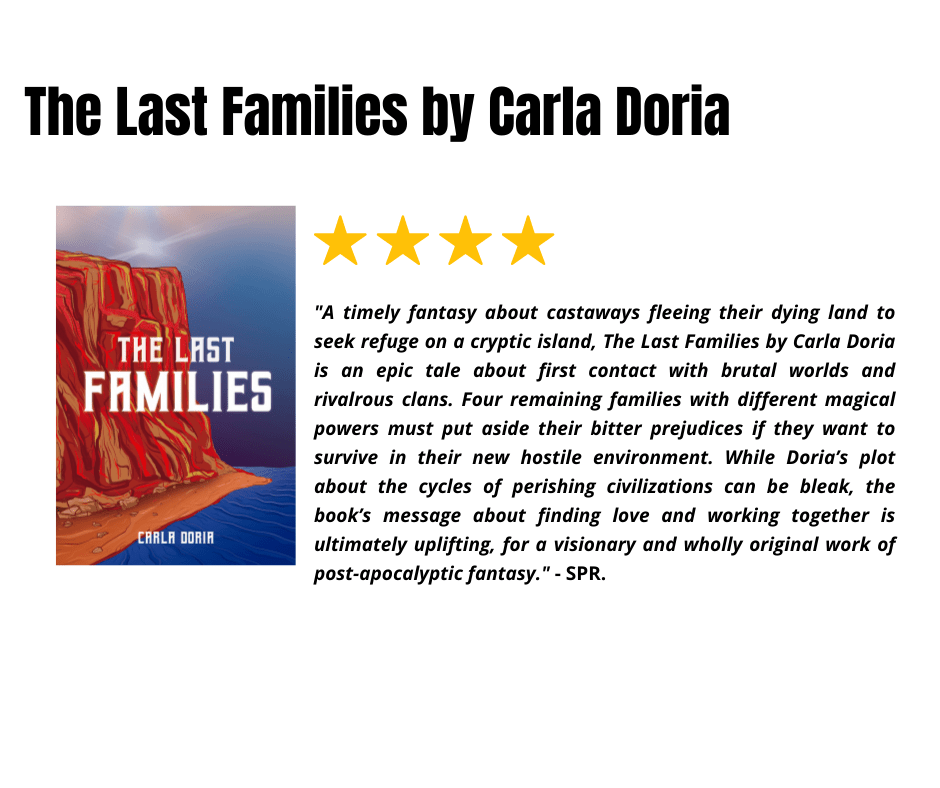
    And in the meantime, if you haven’t checked my latest Editorial Review from SPR:

    https://www.selfpublishingreview.com/editorial-reviews/

    Do you want to get a copy of The Last Families?


    You can also buy it at the following platforms:

    I would greatly appreciate leaving a review if you decide to buy it.

    Do you want to check out the book’s website?

  • Book Release “The Last Families”

    I’m happy to announce the official release of my first fantasy novel “The Last Families”: