Category: The Last Families

  • Is Fantasy the right genre?

    My fantasy book “The Last Families” is a dystopian story that has characters with supernatural powers. But is Fantasy the right genre?

    Almost after 6 months of its release, I have come to this question. Shouldn’t I have properly defined the genre before releasing the book? I supposed I should’ve.

    From the single instant, I began imagining and writing this fantastic world where these characters with talents/superpowers existed, I knew it had to be fantasy. Nothing of that exists or will exist in this world.

    But as I got reviews, most of them quoted “The Last Families” as a dystopian post-apocalyptical story. It got me wondering.

    According to Merriam-webster, a dystopia is:

    an imagined world or society in which people lead wretched, dehumanized, fearful lives

    The Last Families has something of that. It makes sense. It is dystopian because it talks about a future world with less than utopic circumstances. The characters are the last survivors of their world. They are looking for refuge and arrive at a place that is everything but hospitable. Of course, they are fearful as in the definition.

    Is it post-apocalyptic? The definition of post-apocalyptic says:

    existing or occurring after a catastrophically destructive disaster or apocalypse In a postapocalyptic world where nature has become just as violent as humanity 

    So yes, The Last Families definitely complies with this too. The story takes place after their land has been destroyed. We came to assume that these people are somehow future descendants of humans but with certain particularities. Therefore, we could say that this is a future that could somehow exist in the future? I would say overly farfetched.

    Therefore it is a dystopia and a post-apocalyptic story. And it turns out that these two are subgenres of Science Fiction, and not of Fantasy. That is where I was surprised. Being a big reader of Science Fiction, I never thought of The Last Families as belonging to this genre, but somehow it has been categorized under it.

    Now, there is “Science Fantasy”. A new genre. Thank god for new inventions. The definition is familiar:

    Science fantasy is a hybrid genre within speculative fiction that simultaneously draws upon or combines tropes and elements from both science fiction and fantasy.

    I think that is where my book fits better.

    Unfortunately, like many new genres, you won’t find them listed anywhere. If you look for categories with a Print On Demand service, Listing sites, Literary Agents, and Book Reviewers, you will find Romance, Science Fiction, Mystery, Fantasy, Young Adult, and other “general” categories. New genres and Sub-genres are not included.

    So, does this screw things for how I’ve been listing my book? I don’t think so. In fact, I’ll see it as a new opportunity. Until yesterday, the book was mainly targetting Fantasy categories and keywords. Now I’m targetting dystopian, post-apocalyptic, and science fantasy. Maybe a new refreshing audience to target.

    What do you think? Should I still call it Fantasy?

    You haven’t gotten your copy of The Last Families yet?

  • Bolivian Literature

    Amanda Khong from the Bookish Brews website gave me the opportunity to write for her website. I wrote about my struggles with publishing in a language that is not spoken where I live and also my general struggles with self-publishing from a small Latin American country. I’m thrilled by this opportunity.

    I invite you to check the article:

    You haven’t checked my last book yet?

  • Choosing a Print on Demand/ebook distribution service- Part Three

    I never planned to have a third part for these series. You probably realized that I had Part one: Choosing a Print on Demand Service and Part Two: Choosing a Print on Demand service. And the result from both posts was choosing Lulu.com. The plan was that Lulu would be my chosen service for print books and also for ebook distribution. Of course, I wanted to keep it all in one single place. In the end, I had to withdraw my ebook from Lulu and choose another service. Let me tell you what happened:

    • I uploaded the Print book, ordered a proof and had it sent to me (that took me almost 6 weeks but that is not on Lulu’s side but the terrible shipping service to Bolivia, even when paying a more expensive one. It is not even the service to blame, but an ongoing issue with all shipping to Bolivia.)
    Photo by Karolina Grabowska on Pexels.com
    • I contacted Lulu support and asked: “Is there a way for me to plan a launch date?” Everything about book marketing is about having your launch date. You plan ARCs, reviews, etc for the launch date. The short answer from Lulu was: “No”. They give you a 2-4 estimate for ebooks and 4-7 weeks for printed books. That is the time that you have to wait until the book is on Amazon, Apple, Barnes & Noble, etc.
    • I contacted Lulu support and asked “Will I know when the book is listed on a service?” Short answer. “No”. We suggest googling your ISBN starting on week 2. THIS IS annoying. Imagine yourself googling your ISBN every day to know when the book is already listed somewhere.
    • While the printed proof was on the way to far-away Bolivia. I thought that it was time to upload the ebook. I was trying to time both of them given the estimate of weeks that I was given for each version.
    • While I still waited for the printed book, 4 weeks had already passed since I submitted the ebook AND it wasn’t on Amazon. It was everywhere, even platforms I didn’t they existed, but not on Amazon. And to be honest for an ebook, the Amazon kindle version is the most important for your book’s official launch. Even reviewers ask for your Amazon link.
    Photo by Enzo Muu00f1oz on Pexels.com
    • The printed book finally arrived and I can admit that quality was really good. I was happy with that. I approved the book the same day. And guess what? the printed book was already on distribution and on Amazon the very next day. What was going on then with the ebook? Why wasn’t it listed? It was already one month after its submission.
    • I contacted Lulu and they gave an explanation of them having submitted the book to Amazon and not knowing why it wasn’t listed. Great answer! Sigh… They told me to wait a bit more.
    • I waited 2 weeks more. Meanwhile, the printed book was already online, and worst of all, it had been launched with the date when I ordered the proof, 2 months ago. September. That didn’t look good. I was telling people and reviewers that I was waiting for the books to be listed to announce the launching date and the printed book was already there since September 🙁
    • This is the part when I got annoyed with Lulu. I contacted them at least 3 times more. I got autoreplies! from people not available, going on vacation, etc. Horrible customer support. That is when I thought. Do I have to use the same service for print and ebook? Therefore, I went back to my list of considered services and I knew there was one that had strucked me with good support service but was only doing digital: Draft2Digital.
    Photo by Perfecto Capucine on Pexels.com
    • I decided I was going nowhere with Lulu. I thought that at this point I couldn’t wait forever for Amazon to list the ebook. I decided to retire my ebook from Lulu. I submitted it with Draft2Digital and:
    • It turns out that Draft2Digital helps you get a launch date. They tell you when your book is approved and listed with a platform. They tell you everything. They are good with customer service. It took around 3-4 days to have my ebook finally listed with Amazon. If they had the printed service, I would definitely move over with them. Another advantage is that you can select to be paid with PayPal and Payoneer (this is the only option that lets me cash out the money.) Besides their take on sales is lower than Lulu. I already knew this. Lulu’s take is 20% (aside from Global distribution fees) and Draft2Digital is 10%.
    • Funny fact to finish the story? After I retired my ebook from Lulu. They had the nerve to reply to my emails and say they were so sorry about this issue. It turns out they had been having problems with their platform and submissions to Amazon for many ebooks. I work with customer service. It would have made sense to mention that to their customers that in first place.

    Conclusion: Why did I think that I had to use one single service for both versions? The ebook and the printed versions are considered different versions because they have their own ISBN. There is no rule anywhere that says that you have to use the same platform for both versions. For any new writers out there, looking into self-publishing, I hope this post helps with an additional option: publishing different versions with different services. What works better for you.

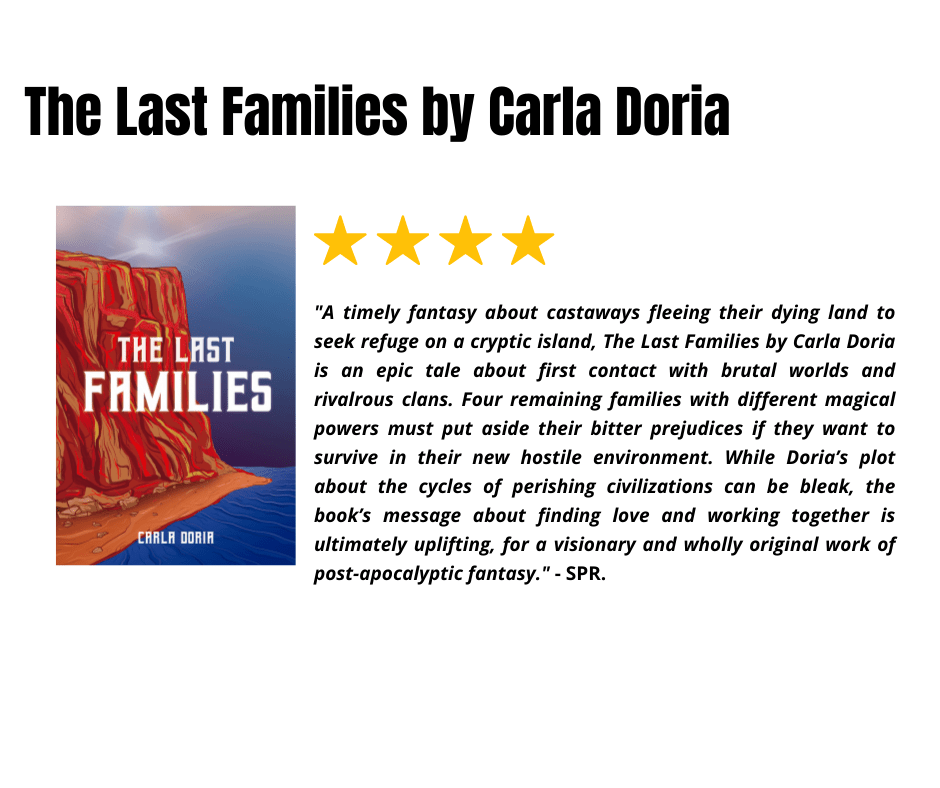
    And in the meantime, if you haven’t checked my latest Editorial Review from SPR:

    https://www.selfpublishingreview.com/editorial-reviews/

    Do you want to get a copy of The Last Families?


    You can also buy it at the following platforms:

    I would greatly appreciate leaving a review if you decide to buy it.

    Do you want to check out the book’s website?

  • Book Release “The Last Families”

    I’m happy to announce the official release of my first fantasy novel “The Last Families”:

  • Understanding ARC and getting reviews

    When I decided I was ready to publish my book, I never thought that getting reviews for the book’s launch would be that difficult. Everywhere you look for information, videos, and tutorials on what to do to launch your book, you get advice about getting early reviewers as part of your book launch “team”. We are not talking about reviews from your friend and family, but reviewers who do book reviews, have a platform of their own (a blog or social media), and can provide their honest review and have it on their platforms. The idea is to have some people talking about your work by the time the book gets launched.

    There are many services that help you with this, meaning that you subscribe to get access to their reviewer database, but they don’t promise reviews. Then there is a more organic way to do this, i.e reaching bloggers or people with a platform and asking them to review your book.

    Photo by cottonbro on Pexels.com

    For any people out there in the process of self-publishing a book, I would like to tell you about my process and struggles with getting reviewers:

    • It won’t be easy. I thought that getting an agent for traditional publishing was difficult. No, getting reviewers is more difficult.
    • You can start requesting reviews before publishing your book. This is a review on your ARC (Advanced Reader Copy). There are services like Booksprout (with accessible prices), NetGalley (expensive) and others. My book is currently submitted in Booksprout in this link. I haven’t received any requests yet.
    • You can also use similar services like Reedsy Discovery to access their reviewers database and get a review by your launch day. The idea is to submit your review request on this platform around 1 week before the launch. It is paid service as well. One thing to take into account that these services clarify that the payment is only for access to their database but reviewers are not paid. Paid reviewers is a no, not only in Amazon, but also ethically.
    • Then there is the organic way to do this: search for book bloggers and social media people that do book reviews. This is like jumping into a sea of never-ending information. I was lucky enough to find this Reedsy list of Book Bloggers where you can find more than 200 bloggers. I went through each blog, read the review policy (where you can see if the blogger takes self-published books, if they read your genre, if they need a printed copy, etc) and emailed around 50 bloggers that read Fantasy and were open to reviewing books at the moment. Like Literry agents, book bloggers are sometimes open and sometimes not. I’ve starting getting some replies already that they are sorry but they won’t be able to review my book. Sigh…
    Photo by cottonbro on Pexels.com
    • Then there is Blog Tours. I learned about them only a couple of months ago when I started this self-publishing project. Usually book bloggers with a high outreach will have their own people (followers) that are part of their network and will get them to either do a review on your book, publish an excerpt about it, do an author interview, or simply upload the book cover and info in their Bookstagram (more about this on a later post) and other social media. These tours are paid and are not very cheap. They usually last in between 1 to 2 weeks, and their packages will offer in between 7 to 15 book bloggers to talk about your book in the time you selected. I’m actually considering the cheapest ones and still thinking of its the advantages. If anybody out there has done a blog tour, please let me know your experience. Blog tours are not specifically reviews, but some participants might choose to do a review on your book, that is why I included it in this post.

    In a next post, I will broaden on other book promotions that I found out there from $5 to the hundreds $$.

    Has anybody had experience with book reviewers? Is there any other tip that I’m missing?

  • Receiving the first copy of my book

    It took around one month for a copy of my printed book to get here. If you remember my previous post where I made a reflection of who I chose a Print on Demand service, you will remember that Lulu was the chosen one.

    In order to start distributing paperback copies and have your book listed under services like Amazon, Barnes & Nobles, Kobo, Google Books, and others, they send you a printed copy of your book for you to approve it. It makes sense, especially when you design the interior and take care of all the formatting needed for the book. You want to make sure that the book is printing well, and the format and design you uploaded are showing correctly before it is distributed to other websites.

    So after uploading my PDF (with all the needed formatting that I had to learn) and uploading a cover file (which was designed by a friend), the paperback copy was ready and therefore, I ordered a copy for “approval”.

    Given my bad experience with carriers like DHL and the terrible Bolivian regular mail, I decided to use a service called Aeropost. It is a service for most Latin American countries. You send your order to an address in Miami (meaning that the shipping inside the US is quite fast and not expensive), and from there they consolidate their packages and bring them over to Bolivia. When I talked with the Aeropost sales representative, they said it would take the most 10 days. It was a decent waiting time for me. I paid online $14, which wasn’t that bad compared to what DHL would charge you, and waited.

    After ten days, I could still see my package not having left Miami. After calls to Aeropost, it turned out that they were using a very low-key military airline to bring the packages over and that airline had stopped their flights. They were trying to negotiate shipping with a new airline. Short story, it took one month for the package to get there. Regular mail would have taken almost the same, around 6 weeks. That delayed all the plans that I had to release the book in November. The book got here at the beginning of this week and I just approved the printed copy on Lulu’s website. Now there is a wait time of 8 weeks, after approval, for your book to be listed on other services. At this pace, I only hope the book will be out there this year (crossing fingers it will be for Christmas).

    I thought it would be fun to record myself at the moment of receiving my book, unpackaging it, and seeing it for the first time. I didn’t know if I was going to use that video for social media or not. Maybe I really didn’t like the book, and my reaction was terrible, but I decided to do it anyway. Anyway, it would be a good memory to recall: that time when I first saw a copy of my first book. The book looks quite good. The cover is awesome and printing has gone very well. All formatting looks top-notch and I feel relieved.

    I thought it would be a good idea to embed this Instagram video here: (if you are not seeing the video play, please click on the image)

    Now, let’s cross fingers I can announce the book’s release for this year.

  • Why Fantasy? Why The Last Families?

    When I started writing several years ago, it took me sometime to decide which was the genre that worked for me the best. I started with thrillers, thinking that it would be difficult to create a fantasy or science fiction world. I love reading thrillers, that can’t be questioned, but I also love reading other genres like fantasy.

    I thought that developing characters and a story in a world that already existed would work for me better as a beginner writer. But setting a story in a current world is not easy. You still have to do research, know the place where it will take place, research about the people in this place, the language they use, etc. After a first manuscript that didn’t work well, I realized that I wasn’t that good at establishing a current environment, so I thought I would give it a try with fantasy.

    But would I be imaginative enough to figure out a whole fictional world? Would I have the words and imagination for world building, aside from character building? I didn’t know. I doubted myself a lot, but I still started with a story that I had a long time in mind.

    When I started writing “The Last Families”, I gave it a simple title “New World”. It was because I was writing about a new world and thought it would be better to name it like that than simply “Manuscript”. I started describing those fantasy landscapes that I had imagined before. It wasn’t that bad and I enjoyed the process. Some time later (a couple of years) here I’m with my first fantasy novel.

    I’m not sure if fantasy is all I’m ever going to write but my next story is still in this genre. There is a mix of science fiction in some parts of The last Families and I’ll probably explore this genre a bit more in the future. Right now, I’m happy that I get to explore my imagination much better than when I was trying to adapt my stories to an existing world just because of writing comfort. I feel better challenging myself.

  • Underlying topics in “The Last Families”

    The fact that a story has fantasy in it doesn’t mean that its whole world is made up and not related to current topics related to our own world. But if it wasn’t because I had to write a pitch, a synopsis, and disclaimers for this book, I wouldn’t have thought of the harsh underlying topics in the story:

    • End of the world /post-apocalyptic. Even though The Last Families happens in a fictional world, there is a background and time to the story. African, the last continent left on Earth, refers to a world that is far in the future, after the other continents have become lost somehow. The Last Families characters are still escaping from this last continent that is now facing its destruction.
    • Skin color/race as a factor to survive – Without going too much into details and telling part of the story here, the new place where the families have arrived, Gambir, has extreme circumstances that make that some people with certain skin color have better chances to survive.
    • Superiority of some families – Some families, like the Ninfires, believe they are superior than others. The idea of a group of people superior to other is still current relevant issue, no matter in which country we are located.
    • Misogyny – This is of course a characteristic that belongs to a villain, Ian, and even though this is a fictional world, unfortunately it can still be present.

    There are still other harsh topics in “The Last Families” but that are better discovered during the story. Of course, this doesn’t mean that the story is only dark, it is also a story of love, leadership, tolerance, sacrifice and compassion.

    Coming soon!

  • The Last Families Website

    When I started working on my launch plan, the website was a no brainer. That is the only thing that I would be able to pull it out myself without hiring somebody else. I’m happy to admit that I really enjoyed the process and the website is ready.

    For any other authors out there that might be seeking into setting up a website for their book, and you are not sure what content to include, after doing some research, this is the content that I included:

    • A Homepage that summarizes most of the website’s content, from the book’s release info, author, contact form, etc. The idea is that most people won’t navigate further than the homepage and won’t even click the navigation menus.
    • An About the Author page. This is a must in a book’s website. I included a short bio- the same that is placed in the back of the book’s cover. I have the belief that it has to include a good picture, people could want to meet/see the author.
    • A link to the Author’s blog, that means to this blog. I don’t think I’ll have a blog section in the book’s website. Maybe in the future. Although I’m not really sure what would I blog about. But in the meantime, I have this blog that has been running since 2015 with over a hundred of posts. So why not link to this blog? That is a good way to get more followers in “The Diaries of the Happy Writer”.
    • A Contact page where anybody can contact me. I’m mostly thinking of people who might be interested in an ARC (Advanced Read Copy) or something like that.
    • The controversial “Fanfiction” page which after some careful consideration in a previous post, I decided to give it a go. It’s not like I’m a world famous author and will get myself into suing readers for copyright issues. The more people that can read my book, the better, and I’m honored if someone ever thinks of writing fanfiction about it.
    • The Reviews page. Although, reviews are preferred in store sites like Amazon or Goodreads, it is still okay for me if people want to leave their review on site. The page will still include, of course, links to the retailers’ sites.

    The homepage links to a synopsis of the story too where I had the chance to use my wonderful illustrations.

    I’m pretty sure this content is not stone-fixed. While this adventure of self-publishing my book continues, I’m pretty sure that I will find myself re-doing certain things. I might need to add other sections to the website that I hadn’t thought before. A blog section could be needed to boost the SEO, for example. But at this stage, I’m happy to say that The Last Families’s website is ready. Please make sure to click the button and subscribe to get updates:

  • The Last Families – The Cover Reveal

    I finally have a cover for my first fantasy novel “The Last Families” and I’m extremely happy to reveal it:

    Printed Version

    Ebook version

    The cliffs in the cover are inspired by the first opening paragraph of the “The Last Families”:

    Blood climbed at least half a mile towards the sky. That was Yarisha’s first impression when she saw the crimson hue that covered the tallest cliffs she’d ever seen. The immense island above them resembled a piece of land floating on the water’s surface. Judging by the marks on the red cliffs, the water could have been higher once. Whatever mineral drenched the rocks, it painted them a deep red. This wasn’t the dreamiest place one would expect, but the families didn’t have anywhere else to go. Their own land had been destroyed.

    The book launches soon in November. Subscribe to this blog to get more updates:

    [jetpack_subscription_form show_subscribers_total=”false” button_on_newline=”false” custom_font_size=”16px” custom_border_radius=”0″ custom_border_weight=”1″ custom_padding=”15″ custom_spacing=”10″ submit_button_classes=”” email_field_classes=”” show_only_email_and_button=”true”]