Tag: self-publishing

  • Understanding ARC and getting reviews

    When I decided I was ready to publish my book, I never thought that getting reviews for the book’s launch would be that difficult. Everywhere you look for information, videos, and tutorials on what to do to launch your book, you get advice about getting early reviewers as part of your book launch “team”. We are not talking about reviews from your friend and family, but reviewers who do book reviews, have a platform of their own (a blog or social media), and can provide their honest review and have it on their platforms. The idea is to have some people talking about your work by the time the book gets launched.

    There are many services that help you with this, meaning that you subscribe to get access to their reviewer database, but they don’t promise reviews. Then there is a more organic way to do this, i.e reaching bloggers or people with a platform and asking them to review your book.
    Photo by cottonbro on Pexels.com

    For any people out there in the process of self-publishing a book, I would like to tell you about my process and struggles with getting reviewers:

    • It won’t be easy. I thought that getting an agent for traditional publishing was difficult. No, getting reviewers is more difficult.
    • You can start requesting reviews before publishing your book. This is a review on your ARC (Advanced Reader Copy). There are services like Booksprout (with accessible prices), NetGalley (expensive) and others. My book is currently submitted in Booksprout in this link. I haven’t received any requests yet.
    • You can also use similar services like Reedsy Discovery to access their reviewers database and get a review by your launch day. The idea is to submit your review request on this platform around 1 week before the launch. It is paid service as well. One thing to take into account that these services clarify that the payment is only for access to their database but reviewers are not paid. Paid reviewers is a no, not only in Amazon, but also ethically.
    • Then there is the organic way to do this: search for book bloggers and social media people that do book reviews. This is like jumping into a sea of never-ending information. I was lucky enough to find this Reedsy list of Book Bloggers where you can find more than 200 bloggers. I went through each blog, read the review policy (where you can see if the blogger takes self-published books, if they read your genre, if they need a printed copy, etc) and emailed around 50 bloggers that read Fantasy and were open to reviewing books at the moment. Like Literry agents, book bloggers are sometimes open and sometimes not. I’ve starting getting some replies already that they are sorry but they won’t be able to review my book. Sigh…
    Photo by cottonbro on Pexels.com
    • Then there is Blog Tours. I learned about them only a couple of months ago when I started this self-publishing project. Usually book bloggers with a high outreach will have their own people (followers) that are part of their network and will get them to either do a review on your book, publish an excerpt about it, do an author interview, or simply upload the book cover and info in their Bookstagram (more about this on a later post) and other social media. These tours are paid and are not very cheap. They usually last in between 1 to 2 weeks, and their packages will offer in between 7 to 15 book bloggers to talk about your book in the time you selected. I’m actually considering the cheapest ones and still thinking of its the advantages. If anybody out there has done a blog tour, please let me know your experience. Blog tours are not specifically reviews, but some participants might choose to do a review on your book, that is why I included it in this post.

    In a next post, I will broaden on other book promotions that I found out there from $5 to the hundreds $$.

    Has anybody had experience with book reviewers? Is there any other tip that I’m missing?

  • The Last Families Website

    When I started working on my launch plan, the website was a no brainer. That is the only thing that I would be able to pull it out myself without hiring somebody else. I’m happy to admit that I really enjoyed the process and the website is ready.

    For any other authors out there that might be seeking into setting up a website for their book, and you are not sure what content to include, after doing some research, this is the content that I included:

    • A Homepage that summarizes most of the website’s content, from the book’s release info, author, contact form, etc. The idea is that most people won’t navigate further than the homepage and won’t even click the navigation menus.
    • An About the Author page. This is a must in a book’s website. I included a short bio- the same that is placed in the back of the book’s cover. I have the belief that it has to include a good picture, people could want to meet/see the author.
    • A link to the Author’s blog, that means to this blog. I don’t think I’ll have a blog section in the book’s website. Maybe in the future. Although I’m not really sure what would I blog about. But in the meantime, I have this blog that has been running since 2015 with over a hundred of posts. So why not link to this blog? That is a good way to get more followers in “The Diaries of the Happy Writer”.
    • A Contact page where anybody can contact me. I’m mostly thinking of people who might be interested in an ARC (Advanced Read Copy) or something like that.
    • The controversial “Fanfiction” page which after some careful consideration in a previous post, I decided to give it a go. It’s not like I’m a world famous author and will get myself into suing readers for copyright issues. The more people that can read my book, the better, and I’m honored if someone ever thinks of writing fanfiction about it.
    • The Reviews page. Although, reviews are preferred in store sites like Amazon or Goodreads, it is still okay for me if people want to leave their review on site. The page will still include, of course, links to the retailers’ sites.

    The homepage links to a synopsis of the story too where I had the chance to use my wonderful illustrations.

    I’m pretty sure this content is not stone-fixed. While this adventure of self-publishing my book continues, I’m pretty sure that I will find myself re-doing certain things. I might need to add other sections to the website that I hadn’t thought before. A blog section could be needed to boost the SEO, for example. But at this stage, I’m happy to say that The Last Families’s website is ready. Please make sure to click the button and subscribe to get updates:

  • Fan Fiction when you are an Author

    If you’ve been a follower of this blog for a long time, you probably know that I started as a fan fiction writer. I don’t have any shame about it. I think that there is no better compliment as an author to have “fans” of your story. These fans have the story so glued in their brains and understand the characters so well, that they want to write a fan fiction about it. They might be looking forward to doing alternative endings, or simply writing scenes that were not mentioned in the book that somehow they can imagine happening. If you write a fan fiction story, it is usually because you liked the story, the characters made an imprint on you, and you feel they deserve your time to write about them.

    Photo by Startup Stock Photos on Pexels.com

    I know that many authors are against fan fiction. To many it looks as if others are stealing their characters and breaching copyright. I thought a lot about this. But being a good follower of many fan fiction platforms, I’m aware that in most of the cases, there is always a disclaimer at the beginning of the story, about who the characters belong to and also author’s recognition.

    Therefore, I would love to have a “The Last Families” (my fantasy novel to be released soon) reader who wanted to write a fan fiction story about it. Building a fan base is quite hard and what better way to encourage fans than allowing them to be creative?

    In addition, for those that are not much into writing, there are also fan-made illustrations. I believe it is an honor to have fans spend time into crafting and drawing illustrations about your characters and/or scenes. I’ve seen many of these illustrations on Pinterest and Tumblr only because I’ve also followed boards of books/stories/movies that I enjoyed and I was excited to see illustrations coming alive.

    Photo by Pixabay on Pexels.com

    I’m about to finish by book’s website. But I’ve come across one idea that I haven’t seen much out there. Maybe there is an author who’s done it but I’m not aware of him or her. I want my readers to feel enticed to write fan fiction stories and to draw/illustrate their favorite characters scenes. I’v been thinking of including a section in the book’s website where they can submit those. The submission form will mostly make sure that there is a disclaimer about the use of my characters and story. I don’t know if it will work. I don’t if it will mess the copyright things. I only want the readers of “The Last Families” to be able to have a space, with the author’s consent, to submit their stories. where they can have their own side plots, alternative endings and unwritten scenes. I also want the readers to find an interactive section on this website where they can read and see fan fiction and illustrations submitted by other readers. I’m not sure if this idea will work or even if I will have people who like the story so much in order to devote time to it. But the idea has been nagging me for a long time. After all, there is no way to avoid from fan fiction happening on other platforms. I’ve been a fan fiction writer myself and it would have been great to submit my stories to the author as a tribute of how much I enjoyed their story. I only know that the I have to dare and try. I don’t have much to lose. It is self-published and I’m the only person who owns the rights. What do you think?

    Photo by Min An on Pexels.com
  • Visuals for my website

    When I decided to self-publish my novel “The Last Families”, I knew there would be many things that I would have to handle myself. One of them was the book’s website. But what is a book’s website supposed to include? I was imagining the Cover, maybe the book’s synapsis and that was it. It would be a pretty simple website and I wasn’t sure how appealing it would be.

    One of the things that I loved about fantasy stories is that you can find lots of fans’ illustrations online. I was thrilled by the idea and decided that I was going to work with a friend who happens to be an illustrator to get some visuals for not only the book’s website but also for future social media makerting. Otherwise, if I only had the cover as my single visual, that would not enough material to use when promoting the book.

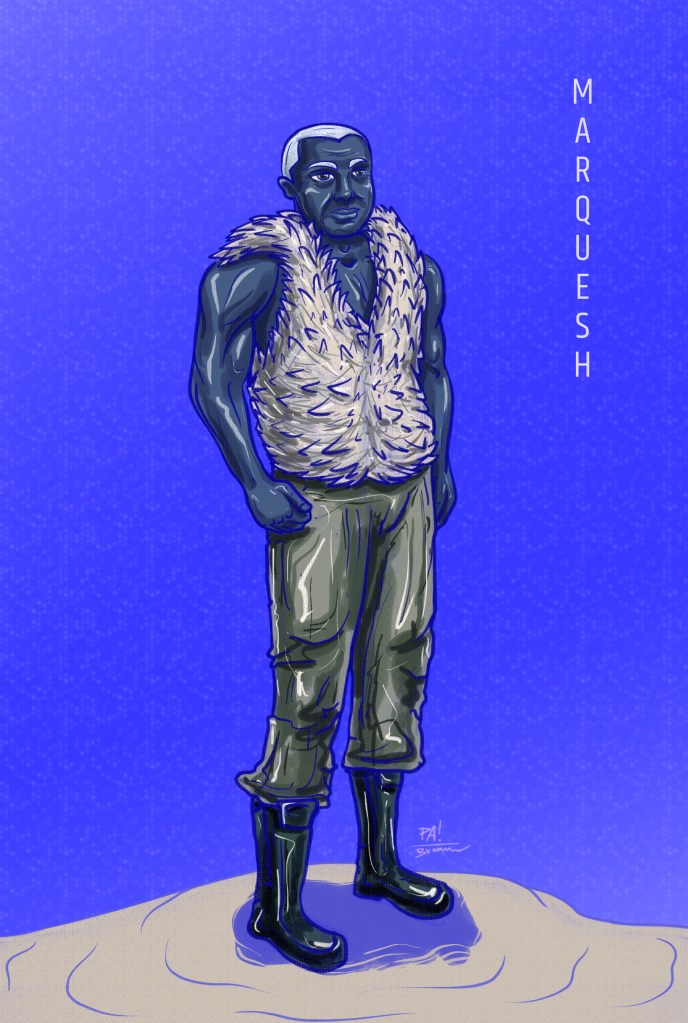
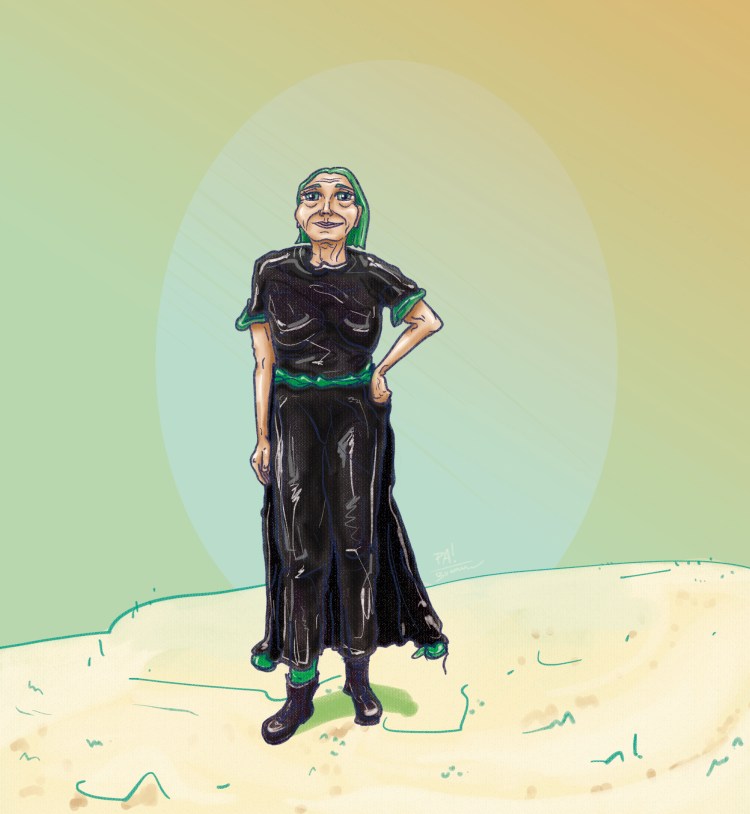
    Therefore, based on the very particular specifics of my characters (purple, red, green hair, etc.) Let me introduce you to my characters’ illustrations that I will add to my novel’s website, including some brief excerpts from the novel that describe them.

    Ian: His short black hair with hard edges around his face made his expression tough. The man stepped down of his horse in one single jump. Small eyes framed a pointy nose, surrounded by very thin eyebrows. A huge, jagged scar drew a line down his throat. Ian wore fur boots and a coat, his attire’s color matching his skin tone.

    Malakay: He was the tallest in the family, with shoulder-length hair, partially pulled back into a bun. He had little resemblance to his father; he had clearly inherited most of his mother’s traits. Malakay’s eyes were darker than usual. In some light, they even seemed black. Having acquired a certain tanned color, his skin wasn’t as white as the rest of his family.

    Yarisha: The Verbaren family leader and the only mind-reader of her kind. According to Malakay, her blue eyes were appealing, and her red hair wasn’t as limp as the other Verbaren girls. She had soft curls that tangled with the wind, bringing some harmony to her face.

    Mandely was probably in her late forties. She was mother to seven Ninfire children, and all had survived this trip. Mandely’s curly lilac hair differentiated her from her children. Her eyes were as big as two full moons. The purple in her eyes shone, making them look even bigger. Her apple-shaped face emphasized her cheeks.

    Marquesh: The Drontas partriarch stepped in front of her field of vision. His silver-white hair contrasted with his black skin. A vest of white fur covered his big, muscled body. The Drontas’ talent was their physical strength.

    Palista: The oldest woman and matriarch had the greenest eyes of the family, and it wasn’t a coincidence. The Kaptarish chose their leader based on the eyes’ brightness. It was said that the green color gave them the power to heat things up. Palista was the oldest person in the family and the oldest of all survivors reaching Gambir. Even though she was a grandmother of ten, she was still strong enough to lead her family.

  • Choosing a Print on Demand service (Second Part)

    In the first part of my post, I started recounting about the Print-On-Demand services that I researched to self-publish my first fantasy novel “The Last Families”. I found many roadblocks on KDP, IngramSpark, and BookBaby. It was time to consider others.


    Photo by Ketut Subiyanto on Pexels.com

    Draft2Digital was my next option. I’ve already been getting newsletters from them and they had good reviews online. I thought this service was meant to be the one. Like BookBaby, Draft2Digital uses PayPal and Payoneer to send payments to authors. PayPal is still an issue for me, since this payment gateway doesn’t completely work in Bolivia (you can’t connect it to a bank account), but you can still receive payments in your PayPal account and use them as available credits for other future online payments. Payoneer, on the other hand, is a better solution for me. I can actually cash out that money with it. Given this payment advantage, I was already excited with Draft2Digital and I thought I had found the one. I’m not sure how I didn’t notice that it was only for ebooks. Print-on- Demand was still on beta and not quite available yet to all their customers. Well, time to go to the next one.

    LuLu or Blurb. Those two were the final ones on my list.

    Weird enough, there weren’t many reviews on Blurb. I had found some comments online that they didn’t get any cut on profits, but other sources said they did. Of course, I planned writing their support to clarify about the profit issue, but in the meantime I had been exploring their platform a bit more. They asked you to download a software on your computer to work with your manuscript and convert it to a printable file. That was the first barrier. I never got their software to work on my computer, and yes, I’m computer savvy. I wrote to their support service and followed the steps they provided but nop, the software didn’t work. I was still giving them a chance and trying to make the software work when I decided to look at their website shop. All these Print-on-Demand services offer you to sell your book on their web shops, besides the big distribution partners (Amazon, Barnes & Noble, etc.) But Blurb is mainly focused on books with visuals/photos- I’ve heard their software does wonders for books with photos for example. Unfortunately, their website shop is not the place where I want my Fantasy novel to be listed. They do list fiction, but it is not their focus and I don’t see any advantage of being listed with them. I doubt any bookshop or small library will look into Blurb’s website for fiction. It is sad, but true at this point. A couple of days later, I found the final barrier when I dug more into their shipping policies, they ship to North America and the EU, but not Bolivia. Sorry, bye Blurb.

    Photo by cottonbro on Pexels.com

    That made me pass to Lulu. And although they pay with PayPal, not Payoneer, it was the option that didn’t present any other harsh barriers. They get 20% of profits. I had to say okay. They ship worldwide. Their website bookshop is not that bad. Their platform is quite easy to follow. They distribute to Amazon and the others. And although, I might only see earnings in the form of PayPal Credits, I guess that is acceptable for the moment. They get you a free ISBN, so that is always good. Therefore, Lulu is the chosen one for the moment. (You don’t have to stick with one of these services, you can always cancel a service with them and work with another in the future).

    I’m also happy to say that I have a second alternative for issues with shipping to Bolivia, using Aeropost. I know since the book is in English, the main book’s market is abroad and not my country, but I still want to have the option to get them to Bolivia. I still want to order around a half-dozen books for friends and family over here. Amazon has been sending things to Bolivia with DHL. And it is the biggest mistake ever. I even called Amazon support about this. I’m not going to go in detail in this post, but aside from what you are charged for Shipping & Handling when you buy at Amazon’s website, you pay a lot of money here to DHL (more than what you paid for the order) for their “additional handling”. DHL Bolivia has these “minimum amounts” they charge for handling your package, even if the product was worth only U$5. Short story, Aeropost is a service for countries like Bolivia and others in Latin America. They give you an address in the US and you ship your orders there. Then they consolidate the packages and charge you for shipping and handling to Bolivia. It is not cheap but their fee is lower compared to the one from DHL. To give you a specific example, DHL charges a minimum of U$45 for handling, aside from custom taxes, for any item that is worth at least $1, in addition to the U$35 you paid for “shipping and handling” in Amazon’s website. It really doesn’t make any sense to me. It is too expensive. You are paying over U$95 (with taxes) to buy a U$10 book. Aeropost charges you shipping (U$17), customs taxes, and $5 for handling. In total, it is less than a third part of DHL’s fees in Bolivia. Unfortunately, those are some issues of living in a third-world country.

    Photo by Liza Summer on Pexels.com

    I know this post had a little bit of everything. And most of you might not have these issues at all. But it is still good to know what happens with other authors out there. My biggest hope is that this post reaches international authors who might be living in countries where these things are common and that my experience helps you a bit. At least to encourage to keep going on.

    My book cover should be ready soon. That is another story for another post. Once it is done, I’ll order my first Lulu copy for approval. So excited about this 🙂

  • Choosing a Print on Demand service

    In this path to self-publishing my first fantasy novel “The Last Families”, I’ve encountered many blocks. There are many services out there to Print-on-Demand, but they are mostly suitable for authors in the US and Canada. I live in Bolivia and that makes things a bit complicated. I don’t think I’m the only author facing these issues so probably this post is going to be helpful to authors in other countries that are not part of North America or the EU (which also has some advantages).

    I started with Amazon’s KDP. Of course being on Amazon is important and I’m planning two formats: a printed paperback and ebook. As soon as I started considering self-publishing, KDP entered my radar. I read all Amazon’s terms and agreements and fount out soon that I would be surrendering to them around 70% profits. Half of that is related to taxes since my country doesn’t have any agreement with the US regarding those. I’m still reviewing all this information to see what options and alternatives I have. Although I didn’t choose KDP for other reasons, soon explained, I still want to sell on Amazon. Therefore, I guess I still have to have this tax thing figured it out.

    Photo by Sagar Soneji on Pexels.com

    The main reason why I didn’t chose KDP is because they pay by check. And yes, this is the only alternative they offer for international authors. I have many issues with that. First, if a check is sent by regular mail to Bolivia, then there are at least 80% chances that it won’t get here. The Mail in Bolivia is a disaster, and at this point, I’m not even sure if it is working with the pandemic. Before Covid, it sort of worked, but it took around four or more months for your correspondence to get to you. Small envelops, postcards, don’t always arrive, they simply get lost. At this moment, I believe the Mail company is heading towards bankruptcy, and as far as I know, mail hasn’t gotten here since 2019. But even if the Mail company started to work and the check managed to get here, there is another issue. I called my bank and asked how much is the fee to cash an international check. They provided the following example: If your check is U$100, the bank has a minimum of U$35 fee for international checks and 15% on the total, so U$50 will be deducted for a U$100 check (which is also the minimum that Amazon pays). That is half of the earnings. No way, I’m going this route.

    Photo by Blue Bird on Pexels.com

    Then I had a quick passage through IngramSpark and quickly found a roadblock when I filled my account and billing details and got a message that more or less said, “Your country doesn’t support digital signatures so we are not able to provide our services at this point.” It was time to move to the next one.

    The next in my list was BookBaby. I always thought it looked quite decent. They distribute to Amazon and other major channels and besides, their online shop, BookShop, is really a good place to have your title listed, even small libraries and bookshops check their site to order some books. From a previous research, I already knew that I needed to buy an upfront plan to publish with them. It seemed to be around U$349 in a quick search. Their main advantage was that they wouldn’t take any profits on books sold on their site or to distributors. After considering this, I decided that it was worth making the investment. However, it was never meant to be only U$349. I navigated all ways on their platform and even called their support service to make sure I was doing things right. I turns out that I needed an initial order of 25 books. There was no way to get a lower quantity, and with shipping to Bolivia, and adding other things like ISBN (which they charge $39), I was soon close to U$1000 before checkout. Nop, discarded.

    And since this story is a bit long, and to avoid getting you bored, I’m going to continue in a next post where I still consider a couple of options more before I get to the final one. See you in a next post in a few days.


  • The book’s website

    I’m continuing on this path to publishing my first fantasy novel. I hope the process can benefit somebody out there. The whole process was delayed a bit due to another personal project I was working on. But I’m glad to announce that I’m back and ready to focus on a very important goal for me, self-publishing my first book. As I started to gather all the info that I would need for a cover, I realized that my fantasy novel would benefit from its own website, which will be mentioned in the back cover’s footer and also inside the book.

    A website for a book can be a little bit tricky. What should you include in that book? A preface, some chapters, reviews? I’m still in the process of figuring that out. But I soon realized that the book would need some visual material aside from the book cover. Given that “The Last families” is a fantasy novel, I thought it would be a good idea to have some sketches/illustrations of my characters. I’m not really sure if this would work for another genre, but I get the feeling that it works well for a fantasy audience. Therefore, I got a friend, Pablo Rico to help me with the illustrations.

    I considered adding those illustrations inside the book (although I never envisioned my book with illustrations), but since an e-book doesn’t support illustrations in color, it won’t make much sense to have then inside the novel’s content (my characters heavily rely on colorful characteristics). Therefore, the illustrations will be mainly used in the book’s website (currently being built) and promotion on social media when I’m ready to launch the book.

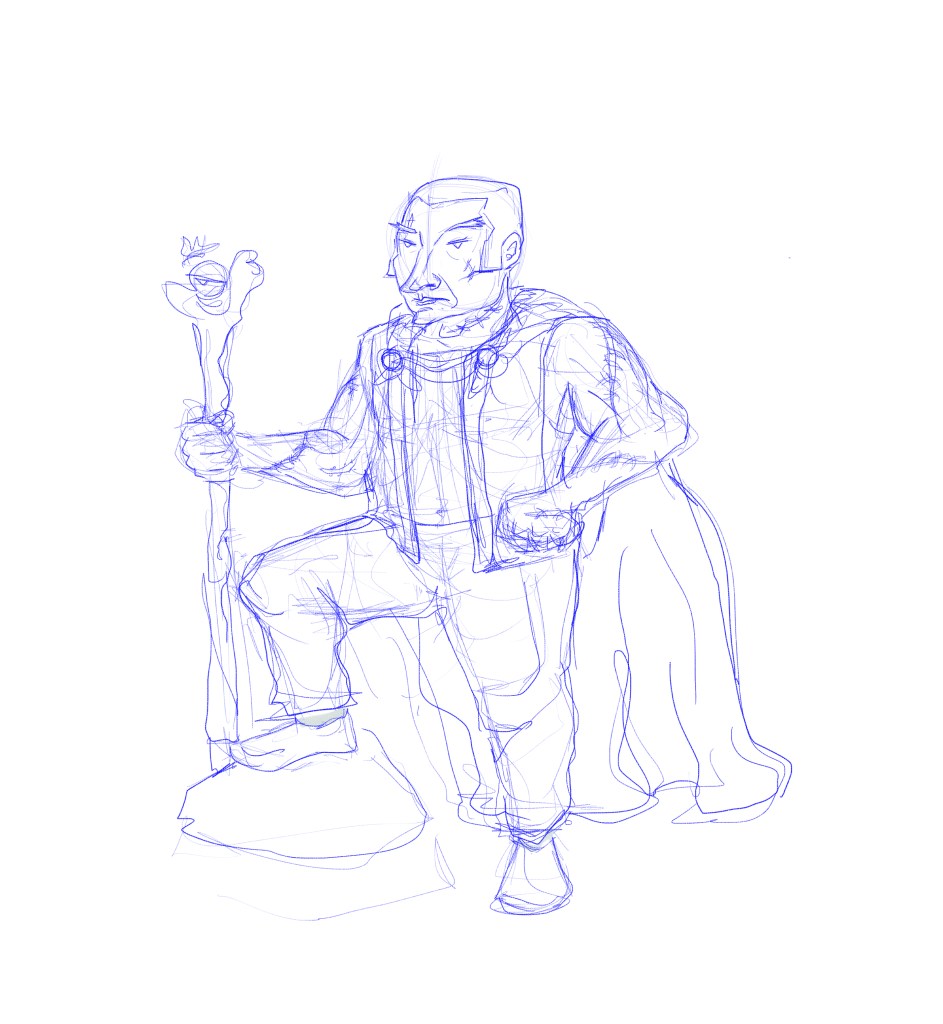
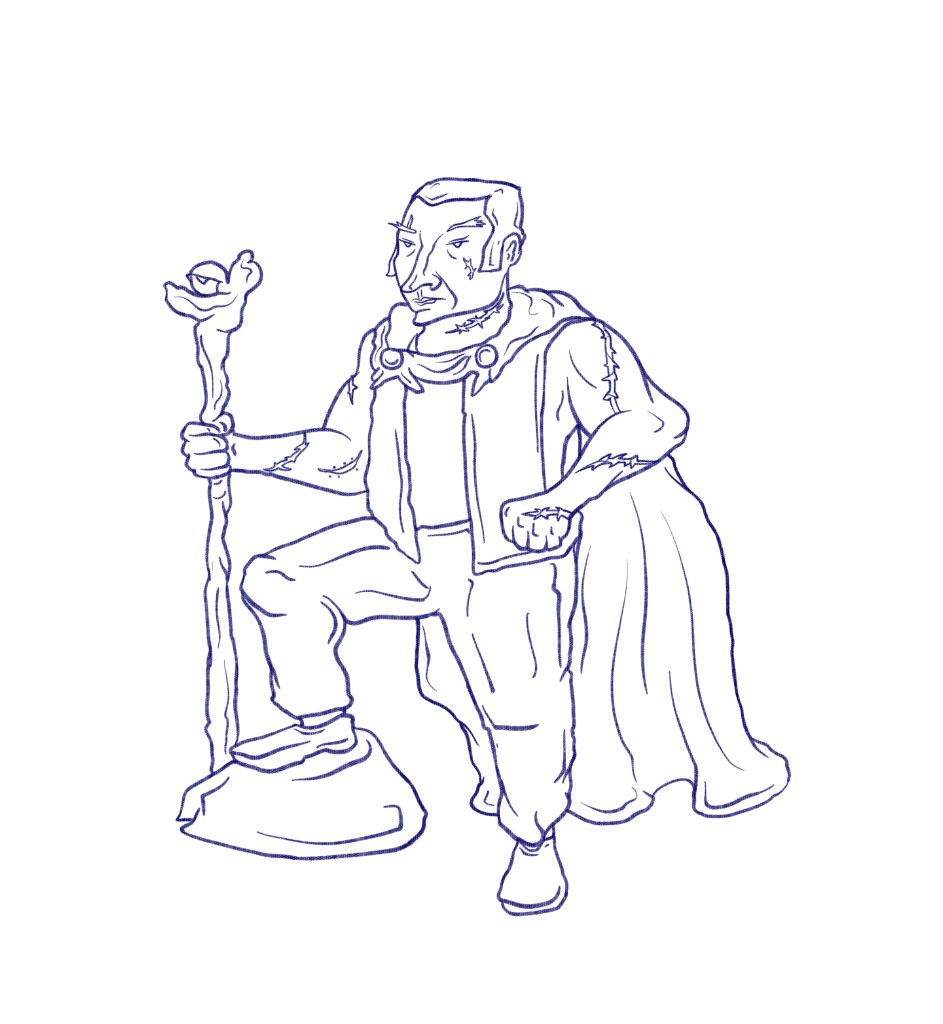
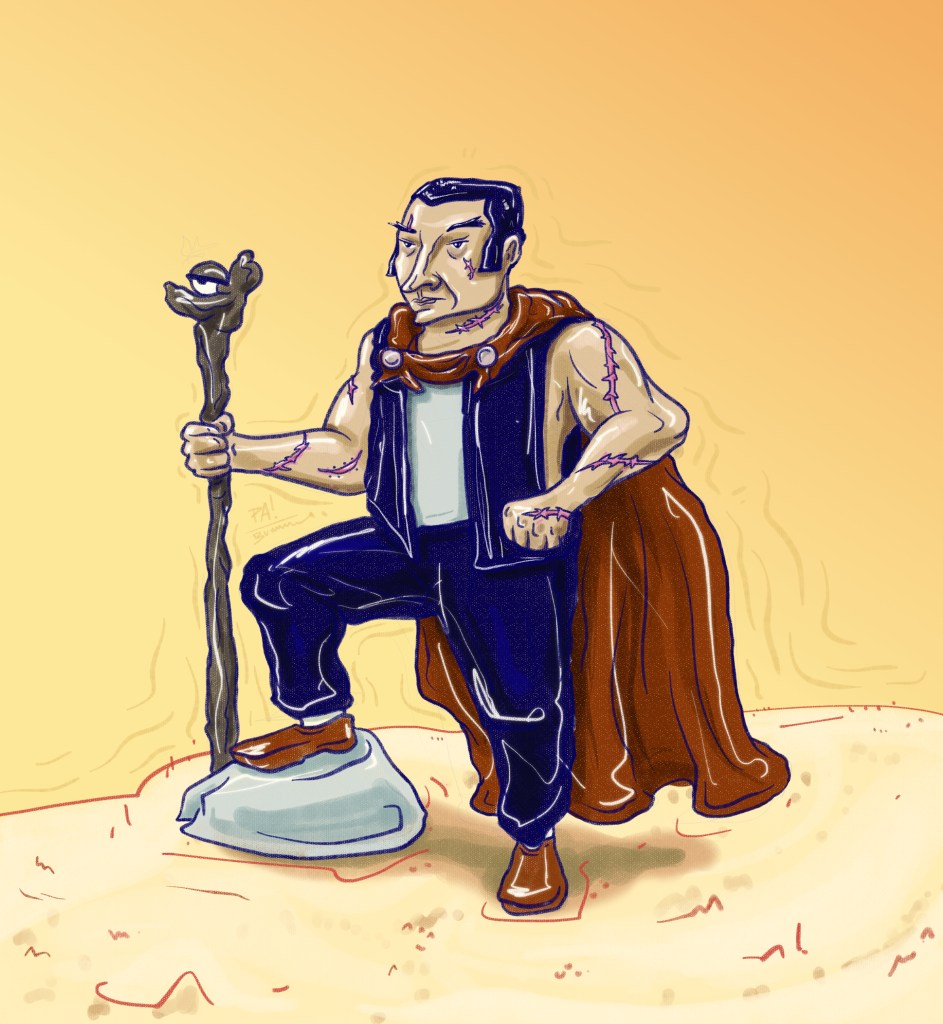
    I thought I would share with you some of the process that Pablo shared with me when creating one of the villains in the story, Ian (please check his Instagram ,he is really a brilliant artist) I loved seeing my character becoming alive.

    This is Ian. He is one of the villains, if not “the villain” in “The Last Families”. He is a native of Gambir (the island where the story takes place) and here is an extract of his character description:

    Only the dark-haired man stepped down from his horse. His short black hair was cut into a square outline around his face. Brown eyes, tanned skin, long nose, and almost purple lips distinguished his face. He was tall and muscular. A long brown fur vest stretched down to his calves. Completing his outfit, he wore a black inner vest and dark fabric pants.

    He is the leader. Mandely knew. And even if he wasn’t, he exerted authority among the other people, remaining one step in front of the others…

    The last families


    I’m hoping to have more information about my book’s website in a next post and share more about the process itself.

    What do you think about Ian? Wanting to know more about him?

  • About the Last Families

    “The Last Families” is the title that I decided to give my fantasy novel. This is the first piece of fantasy I have ever tried to write. Since I didn’t feel confident to do the research required to place my story in a specific location, I decided to give the fantasy genre a shot. I soon realized that I felt comfortable with creating my own world.

    Photo by Pixabay on Pexels.com

    After doing some research, my story falls in the category of “high-fantasy”. The definition of high fantasy, according to Wikipedia is:

    High fantasy is set in an alternative, fictional (“secondary”) world, rather than the “real” or “primary” world.[2] This secondary world is usually internally consistent, but its rules differ from those of the primary world. By contrast, low fantasy is characterized by being set in earth, the primary or real world, or a rational and familiar fictional world with the inclusion of magical elements.

    After giving the warning of being high-fantasy, let me tell a bit more about my story:

    The last continent left on earth is perishing. Escaping through the earth’s core, the last families have reached Gambir. The island’s scorching hot sun and shores that can suck boats into a deep abyss are only some minor dangers compared to its inhabitants.

    Characterized by purple, white, green, and red hair and unmistakable eye colors, each family has unique physiologies. Ninfire women can not only get pregnant in their eighties but also fly. Drontas twins die when their sibling does in spite of the family’s unnatural force. The green family, the Kaptarish, can burn anything they touch with their hands while the Verbaren– composed of only cousins since women can only have one child -used to read minds. 

    The apparent leader of Gambir, Ian, has set eyes on Yarisha Verbaren – the only mind-reader of the Verbaren family. But the young girl has developed feelings for Malakay, the most arrogant sibling in the Ninfire family. She knows the young man’s mother and the matriarch of the Ninfires, Mandely, will never consent to this relationship since she considers the Verbaren family to be inferior. 

    Meanwhile, trying to seek refuge and build a good relationship with the island’s inhabitants, Marquesh, the patriarch of the Drontas family will need to leave his wife in order to protect his children. He will get help from Palista, the old Kaptarish family matriarch. What he doesn’t know is that the old woman hides a secret and that she must hurry to pass her leadership skills to her grandson. 

    Soon these families will find out that skin color could determine their survival. In their quest to escape, they will uncover who is really in charge in Gambir, and learn not only from this island, but also from their inner personal strengths. 

    As you probably noticed, this summary has been extracted from my query letter. It is hard to summarize the story but I’m happy to talk a bit more about it in other posts.

    Photo by Ylanite Koppens on Pexels.com

    Since I decided on self-publishing, I’m planning to set up a website for the book. A friend of mine is helping with some illustrations and they are looking fantastic so far. I’m looking forward to showing them in a next post as I delve myself into this process of self-publishing. I hope that my experience in this process will be somehow helpful to others.

    What do you think of the premise of my fantasy story? I would like to hear some impressions

  • Self-publishing time

    I always told myself that I would explore the different approaches to publishing. The first one, traditional publishing, seemed to be the desired one since you imagine a literary agent guiding you in these waters of publishing. You imagine them taking care of all the logistics that is involved in publishing your book so you can focus in more writing. But as I already knew, nailing a literary agent, and then a publishing house, is not easy at all. I’ve even heard that I would waste my time searching for an agent. But since I was in no hurry to publish, I decided I would try pitching agents first. And I have done it in the past 8 months. I’ve pitched to many agents. Some of them were polite to reply and say “thanks but no thanks” and others didn’t even reply. I must admit that I was sort of expecting this outcome given how difficult I’ve heard is to call the attention of a literary agent. But I still wanted to give a try.

    Now, I’m ready to move on to plan B. Self-publishing.

    Photo by Talha R on Pexels.com

    I wasn’t that scared of the logistics of self-publishing. I knew I could find my way around and hire help where I needed, but I was a bit scared of the time it would take to figure all this out and the time it would involve managing all the process. But at this point, I have the feeling that I have to get my fantasy novel “The Last Families” out there. I’ve spent a couple of years on it and it deserves to be out there. It is a personal challenge.

    I’ve taken on self-publishing planning now, wanting to go slowly step by step. Time is my constraint. I have a good day job, and aside from that job, I’m organizing a tech online event, I attend two Public Speaking clubs, one reading club, and try to stay as physically active as possible. But publishing this book is important and I have to find it time. Moreover, it is time to stop wishing some literary agent will fall from the sky to help with all the hassle 🙂

    Photo by OVAN on Pexels.com

    Therefore, I’ve started gathering information. I’ve already decided I want both the ebook version and the printed version. Given that, there is a lot to do on the matter of formatting the book, getting a cover designed, etc. I’ve already began researching Print On demand services and I’ve already discarded a couple of them. Given that I’m in Bolivia, some of these services don’t deal with authors from outside the US, or as I was told by IngramSpark “digital signature is not supported in your country”. Well….

    On the good side, I’m positive on the design and promotion part. I think I know good people that can help me with that.

    Photo by Ron Lach on Pexels.com

    As I post on this Blog more about the process, I will probably start changing its look, given that the domain name already has my author name, and this will probably become my Author website.

    I’ll start talking a bit more about my fantasy story in next posts so that you can hear what is it about. I’m waiting first on some visual materials to go with this.

    In the meantime, if anybody has good references or experiences with the Print on demand options, I would deeply appreciate to hear from you. Wish me good luck in this process. 🙂