Tag: writing

  • Understanding ARC and getting reviews

    When I decided I was ready to publish my book, I never thought that getting reviews for the book’s launch would be that difficult. Everywhere you look for information, videos, and tutorials on what to do to launch your book, you get advice about getting early reviewers as part of your book launch “team”. We are not talking about reviews from your friend and family, but reviewers who do book reviews, have a platform of their own (a blog or social media), and can provide their honest review and have it on their platforms. The idea is to have some people talking about your work by the time the book gets launched.

    There are many services that help you with this, meaning that you subscribe to get access to their reviewer database, but they don’t promise reviews. Then there is a more organic way to do this, i.e reaching bloggers or people with a platform and asking them to review your book.
    Photo by cottonbro on Pexels.com

    For any people out there in the process of self-publishing a book, I would like to tell you about my process and struggles with getting reviewers:

    • It won’t be easy. I thought that getting an agent for traditional publishing was difficult. No, getting reviewers is more difficult.
    • You can start requesting reviews before publishing your book. This is a review on your ARC (Advanced Reader Copy). There are services like Booksprout (with accessible prices), NetGalley (expensive) and others. My book is currently submitted in Booksprout in this link. I haven’t received any requests yet.
    • You can also use similar services like Reedsy Discovery to access their reviewers database and get a review by your launch day. The idea is to submit your review request on this platform around 1 week before the launch. It is paid service as well. One thing to take into account that these services clarify that the payment is only for access to their database but reviewers are not paid. Paid reviewers is a no, not only in Amazon, but also ethically.
    • Then there is the organic way to do this: search for book bloggers and social media people that do book reviews. This is like jumping into a sea of never-ending information. I was lucky enough to find this Reedsy list of Book Bloggers where you can find more than 200 bloggers. I went through each blog, read the review policy (where you can see if the blogger takes self-published books, if they read your genre, if they need a printed copy, etc) and emailed around 50 bloggers that read Fantasy and were open to reviewing books at the moment. Like Literry agents, book bloggers are sometimes open and sometimes not. I’ve starting getting some replies already that they are sorry but they won’t be able to review my book. Sigh…
    Photo by cottonbro on Pexels.com
    • Then there is Blog Tours. I learned about them only a couple of months ago when I started this self-publishing project. Usually book bloggers with a high outreach will have their own people (followers) that are part of their network and will get them to either do a review on your book, publish an excerpt about it, do an author interview, or simply upload the book cover and info in their Bookstagram (more about this on a later post) and other social media. These tours are paid and are not very cheap. They usually last in between 1 to 2 weeks, and their packages will offer in between 7 to 15 book bloggers to talk about your book in the time you selected. I’m actually considering the cheapest ones and still thinking of its the advantages. If anybody out there has done a blog tour, please let me know your experience. Blog tours are not specifically reviews, but some participants might choose to do a review on your book, that is why I included it in this post.

    In a next post, I will broaden on other book promotions that I found out there from $5 to the hundreds $$.

    Has anybody had experience with book reviewers? Is there any other tip that I’m missing?

  • Receiving the first copy of my book

    It took around one month for a copy of my printed book to get here. If you remember my previous post where I made a reflection of who I chose a Print on Demand service, you will remember that Lulu was the chosen one.

    In order to start distributing paperback copies and have your book listed under services like Amazon, Barnes & Nobles, Kobo, Google Books, and others, they send you a printed copy of your book for you to approve it. It makes sense, especially when you design the interior and take care of all the formatting needed for the book. You want to make sure that the book is printing well, and the format and design you uploaded are showing correctly before it is distributed to other websites.

    So after uploading my PDF (with all the needed formatting that I had to learn) and uploading a cover file (which was designed by a friend), the paperback copy was ready and therefore, I ordered a copy for “approval”.

    Given my bad experience with carriers like DHL and the terrible Bolivian regular mail, I decided to use a service called Aeropost. It is a service for most Latin American countries. You send your order to an address in Miami (meaning that the shipping inside the US is quite fast and not expensive), and from there they consolidate their packages and bring them over to Bolivia. When I talked with the Aeropost sales representative, they said it would take the most 10 days. It was a decent waiting time for me. I paid online $14, which wasn’t that bad compared to what DHL would charge you, and waited.

    After ten days, I could still see my package not having left Miami. After calls to Aeropost, it turned out that they were using a very low-key military airline to bring the packages over and that airline had stopped their flights. They were trying to negotiate shipping with a new airline. Short story, it took one month for the package to get there. Regular mail would have taken almost the same, around 6 weeks. That delayed all the plans that I had to release the book in November. The book got here at the beginning of this week and I just approved the printed copy on Lulu’s website. Now there is a wait time of 8 weeks, after approval, for your book to be listed on other services. At this pace, I only hope the book will be out there this year (crossing fingers it will be for Christmas).

    I thought it would be fun to record myself at the moment of receiving my book, unpackaging it, and seeing it for the first time. I didn’t know if I was going to use that video for social media or not. Maybe I really didn’t like the book, and my reaction was terrible, but I decided to do it anyway. Anyway, it would be a good memory to recall: that time when I first saw a copy of my first book. The book looks quite good. The cover is awesome and printing has gone very well. All formatting looks top-notch and I feel relieved.

    I thought it would be a good idea to embed this Instagram video here: (if you are not seeing the video play, please click on the image)

    Now, let’s cross fingers I can announce the book’s release for this year.

  • Why Fantasy? Why The Last Families?

    When I started writing several years ago, it took me sometime to decide which was the genre that worked for me the best. I started with thrillers, thinking that it would be difficult to create a fantasy or science fiction world. I love reading thrillers, that can’t be questioned, but I also love reading other genres like fantasy.

    I thought that developing characters and a story in a world that already existed would work for me better as a beginner writer. But setting a story in a current world is not easy. You still have to do research, know the place where it will take place, research about the people in this place, the language they use, etc. After a first manuscript that didn’t work well, I realized that I wasn’t that good at establishing a current environment, so I thought I would give it a try with fantasy.

    But would I be imaginative enough to figure out a whole fictional world? Would I have the words and imagination for world building, aside from character building? I didn’t know. I doubted myself a lot, but I still started with a story that I had a long time in mind.

    When I started writing “The Last Families”, I gave it a simple title “New World”. It was because I was writing about a new world and thought it would be better to name it like that than simply “Manuscript”. I started describing those fantasy landscapes that I had imagined before. It wasn’t that bad and I enjoyed the process. Some time later (a couple of years) here I’m with my first fantasy novel.

    I’m not sure if fantasy is all I’m ever going to write but my next story is still in this genre. There is a mix of science fiction in some parts of The last Families and I’ll probably explore this genre a bit more in the future. Right now, I’m happy that I get to explore my imagination much better than when I was trying to adapt my stories to an existing world just because of writing comfort. I feel better challenging myself.

  • Underlying topics in “The Last Families”

    The fact that a story has fantasy in it doesn’t mean that its whole world is made up and not related to current topics related to our own world. But if it wasn’t because I had to write a pitch, a synopsis, and disclaimers for this book, I wouldn’t have thought of the harsh underlying topics in the story:

    • End of the world /post-apocalyptic. Even though The Last Families happens in a fictional world, there is a background and time to the story. African, the last continent left on Earth, refers to a world that is far in the future, after the other continents have become lost somehow. The Last Families characters are still escaping from this last continent that is now facing its destruction.
    • Skin color/race as a factor to survive – Without going too much into details and telling part of the story here, the new place where the families have arrived, Gambir, has extreme circumstances that make that some people with certain skin color have better chances to survive.
    • Superiority of some families – Some families, like the Ninfires, believe they are superior than others. The idea of a group of people superior to other is still current relevant issue, no matter in which country we are located.
    • Misogyny – This is of course a characteristic that belongs to a villain, Ian, and even though this is a fictional world, unfortunately it can still be present.

    There are still other harsh topics in “The Last Families” but that are better discovered during the story. Of course, this doesn’t mean that the story is only dark, it is also a story of love, leadership, tolerance, sacrifice and compassion.

    Coming soon!

  • The book’s website

    I’m continuing on this path to publishing my first fantasy novel. I hope the process can benefit somebody out there. The whole process was delayed a bit due to another personal project I was working on. But I’m glad to announce that I’m back and ready to focus on a very important goal for me, self-publishing my first book. As I started to gather all the info that I would need for a cover, I realized that my fantasy novel would benefit from its own website, which will be mentioned in the back cover’s footer and also inside the book.

    A website for a book can be a little bit tricky. What should you include in that book? A preface, some chapters, reviews? I’m still in the process of figuring that out. But I soon realized that the book would need some visual material aside from the book cover. Given that “The Last families” is a fantasy novel, I thought it would be a good idea to have some sketches/illustrations of my characters. I’m not really sure if this would work for another genre, but I get the feeling that it works well for a fantasy audience. Therefore, I got a friend, Pablo Rico to help me with the illustrations.

    I considered adding those illustrations inside the book (although I never envisioned my book with illustrations), but since an e-book doesn’t support illustrations in color, it won’t make much sense to have then inside the novel’s content (my characters heavily rely on colorful characteristics). Therefore, the illustrations will be mainly used in the book’s website (currently being built) and promotion on social media when I’m ready to launch the book.

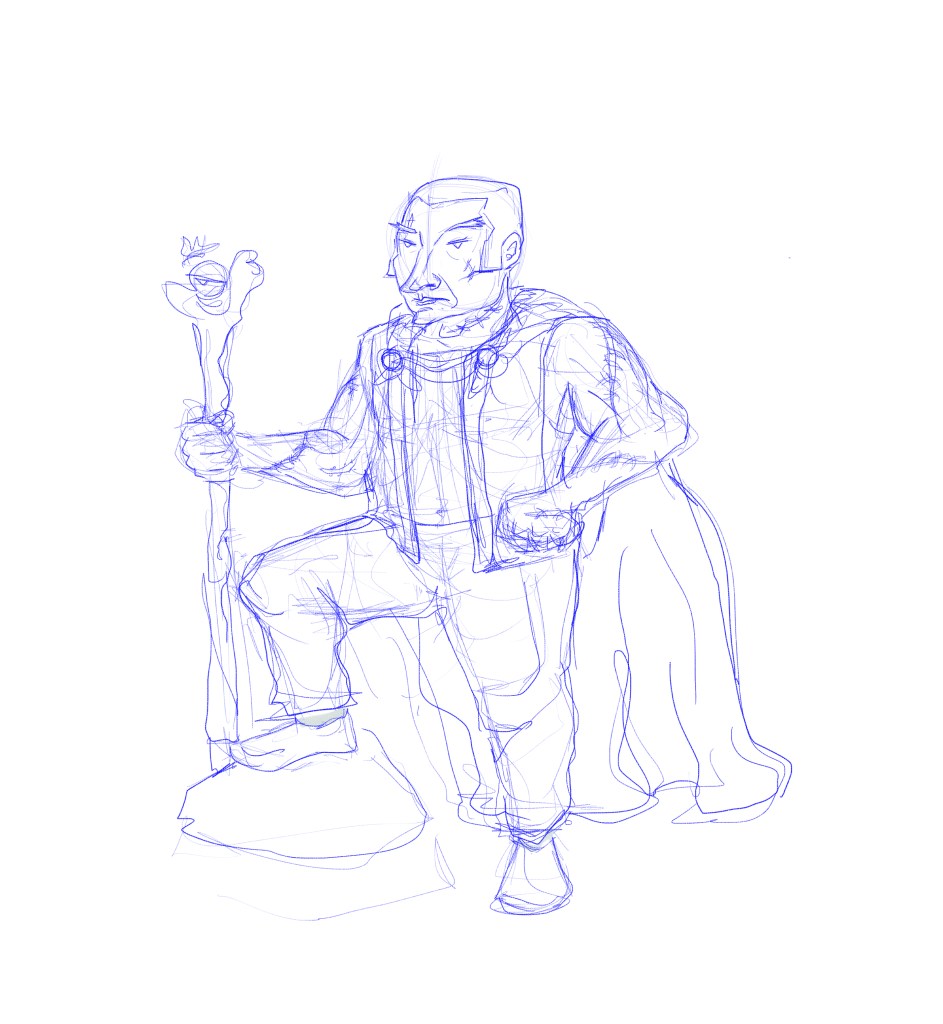
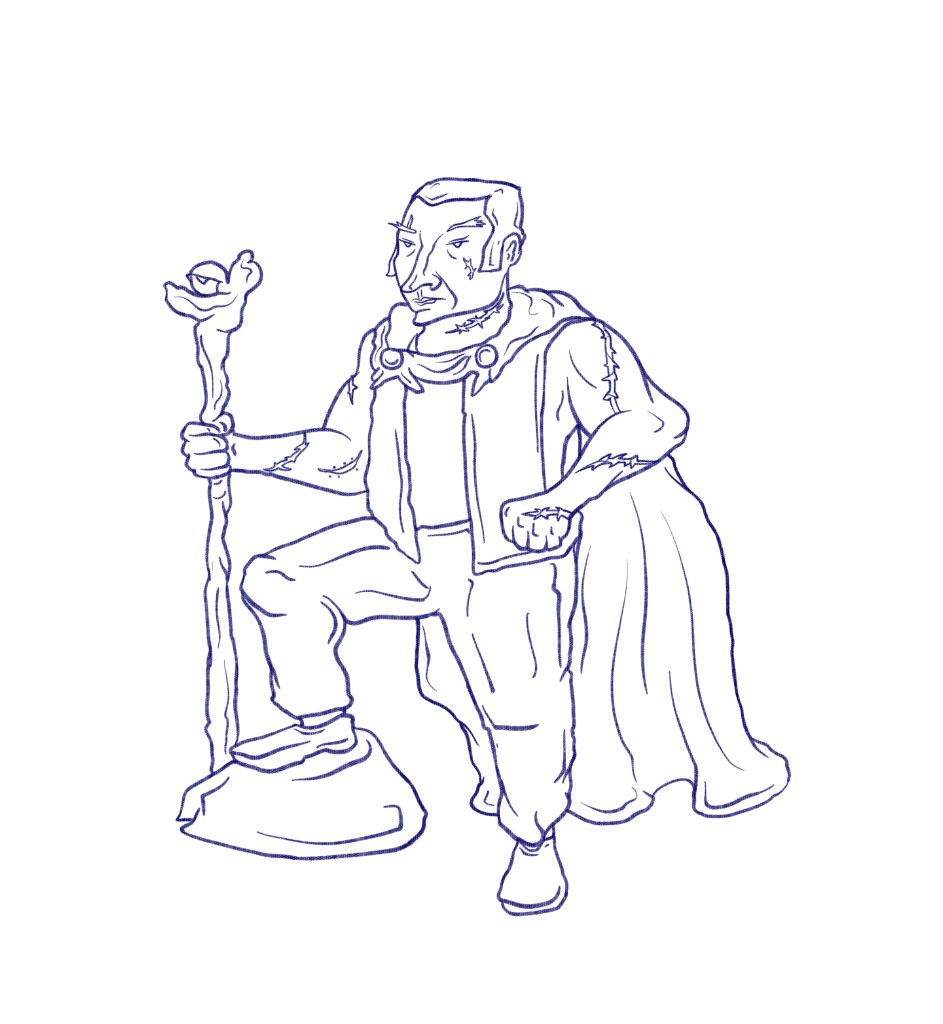
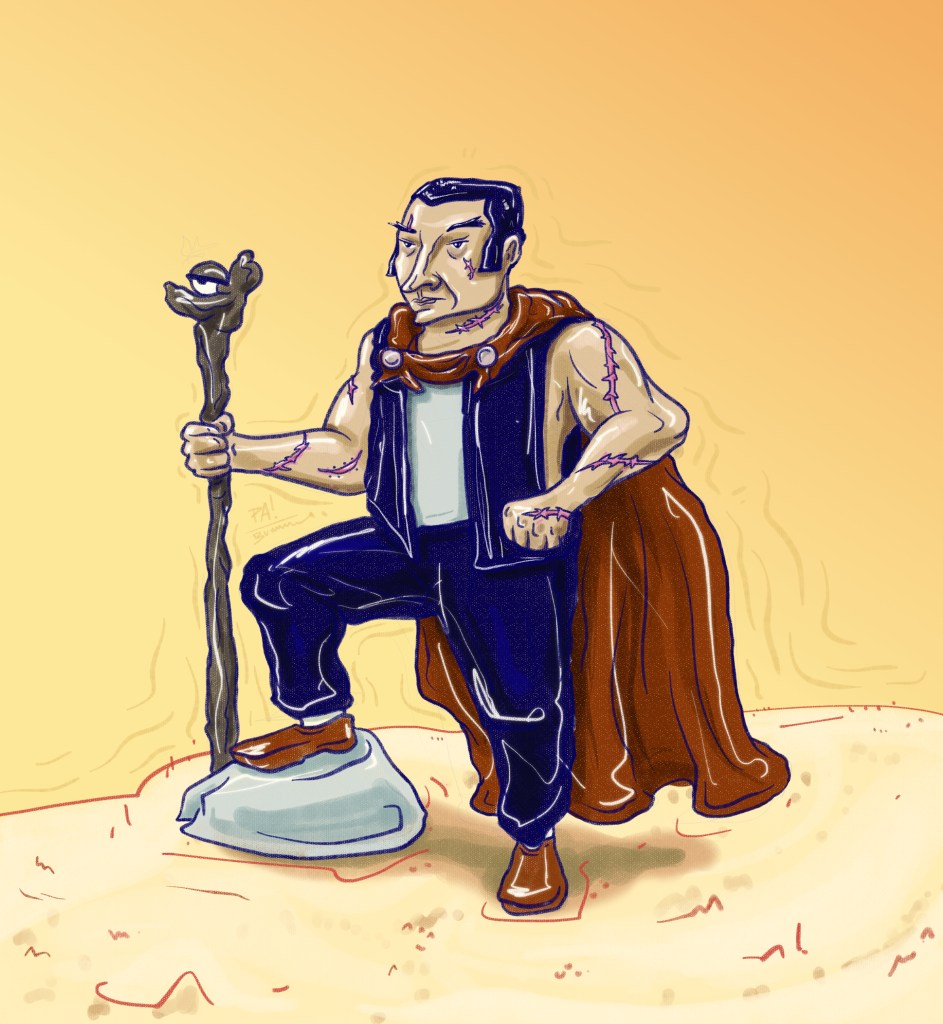
    I thought I would share with you some of the process that Pablo shared with me when creating one of the villains in the story, Ian (please check his Instagram ,he is really a brilliant artist) I loved seeing my character becoming alive.

    This is Ian. He is one of the villains, if not “the villain” in “The Last Families”. He is a native of Gambir (the island where the story takes place) and here is an extract of his character description:

    Only the dark-haired man stepped down from his horse. His short black hair was cut into a square outline around his face. Brown eyes, tanned skin, long nose, and almost purple lips distinguished his face. He was tall and muscular. A long brown fur vest stretched down to his calves. Completing his outfit, he wore a black inner vest and dark fabric pants.

    He is the leader. Mandely knew. And even if he wasn’t, he exerted authority among the other people, remaining one step in front of the others…

    The last families


    I’m hoping to have more information about my book’s website in a next post and share more about the process itself.

    What do you think about Ian? Wanting to know more about him?

  • About the Last Families

    “The Last Families” is the title that I decided to give my fantasy novel. This is the first piece of fantasy I have ever tried to write. Since I didn’t feel confident to do the research required to place my story in a specific location, I decided to give the fantasy genre a shot. I soon realized that I felt comfortable with creating my own world.

    Photo by Pixabay on Pexels.com

    After doing some research, my story falls in the category of “high-fantasy”. The definition of high fantasy, according to Wikipedia is:

    High fantasy is set in an alternative, fictional (“secondary”) world, rather than the “real” or “primary” world.[2] This secondary world is usually internally consistent, but its rules differ from those of the primary world. By contrast, low fantasy is characterized by being set in earth, the primary or real world, or a rational and familiar fictional world with the inclusion of magical elements.

    After giving the warning of being high-fantasy, let me tell a bit more about my story:

    The last continent left on earth is perishing. Escaping through the earth’s core, the last families have reached Gambir. The island’s scorching hot sun and shores that can suck boats into a deep abyss are only some minor dangers compared to its inhabitants.

    Characterized by purple, white, green, and red hair and unmistakable eye colors, each family has unique physiologies. Ninfire women can not only get pregnant in their eighties but also fly. Drontas twins die when their sibling does in spite of the family’s unnatural force. The green family, the Kaptarish, can burn anything they touch with their hands while the Verbaren– composed of only cousins since women can only have one child -used to read minds. 

    The apparent leader of Gambir, Ian, has set eyes on Yarisha Verbaren – the only mind-reader of the Verbaren family. But the young girl has developed feelings for Malakay, the most arrogant sibling in the Ninfire family. She knows the young man’s mother and the matriarch of the Ninfires, Mandely, will never consent to this relationship since she considers the Verbaren family to be inferior. 

    Meanwhile, trying to seek refuge and build a good relationship with the island’s inhabitants, Marquesh, the patriarch of the Drontas family will need to leave his wife in order to protect his children. He will get help from Palista, the old Kaptarish family matriarch. What he doesn’t know is that the old woman hides a secret and that she must hurry to pass her leadership skills to her grandson. 

    Soon these families will find out that skin color could determine their survival. In their quest to escape, they will uncover who is really in charge in Gambir, and learn not only from this island, but also from their inner personal strengths. 

    As you probably noticed, this summary has been extracted from my query letter. It is hard to summarize the story but I’m happy to talk a bit more about it in other posts.

    Photo by Ylanite Koppens on Pexels.com

    Since I decided on self-publishing, I’m planning to set up a website for the book. A friend of mine is helping with some illustrations and they are looking fantastic so far. I’m looking forward to showing them in a next post as I delve myself into this process of self-publishing. I hope that my experience in this process will be somehow helpful to others.

    What do you think of the premise of my fantasy story? I would like to hear some impressions

  • Self-publishing time

    I always told myself that I would explore the different approaches to publishing. The first one, traditional publishing, seemed to be the desired one since you imagine a literary agent guiding you in these waters of publishing. You imagine them taking care of all the logistics that is involved in publishing your book so you can focus in more writing. But as I already knew, nailing a literary agent, and then a publishing house, is not easy at all. I’ve even heard that I would waste my time searching for an agent. But since I was in no hurry to publish, I decided I would try pitching agents first. And I have done it in the past 8 months. I’ve pitched to many agents. Some of them were polite to reply and say “thanks but no thanks” and others didn’t even reply. I must admit that I was sort of expecting this outcome given how difficult I’ve heard is to call the attention of a literary agent. But I still wanted to give a try.

    Now, I’m ready to move on to plan B. Self-publishing.

    Photo by Talha R on Pexels.com

    I wasn’t that scared of the logistics of self-publishing. I knew I could find my way around and hire help where I needed, but I was a bit scared of the time it would take to figure all this out and the time it would involve managing all the process. But at this point, I have the feeling that I have to get my fantasy novel “The Last Families” out there. I’ve spent a couple of years on it and it deserves to be out there. It is a personal challenge.

    I’ve taken on self-publishing planning now, wanting to go slowly step by step. Time is my constraint. I have a good day job, and aside from that job, I’m organizing a tech online event, I attend two Public Speaking clubs, one reading club, and try to stay as physically active as possible. But publishing this book is important and I have to find it time. Moreover, it is time to stop wishing some literary agent will fall from the sky to help with all the hassle 🙂

    Photo by OVAN on Pexels.com

    Therefore, I’ve started gathering information. I’ve already decided I want both the ebook version and the printed version. Given that, there is a lot to do on the matter of formatting the book, getting a cover designed, etc. I’ve already began researching Print On demand services and I’ve already discarded a couple of them. Given that I’m in Bolivia, some of these services don’t deal with authors from outside the US, or as I was told by IngramSpark “digital signature is not supported in your country”. Well….

    On the good side, I’m positive on the design and promotion part. I think I know good people that can help me with that.

    Photo by Ron Lach on Pexels.com

    As I post on this Blog more about the process, I will probably start changing its look, given that the domain name already has my author name, and this will probably become my Author website.

    I’ll start talking a bit more about my fantasy story in next posts so that you can hear what is it about. I’m waiting first on some visual materials to go with this.

    In the meantime, if anybody has good references or experiences with the Print on demand options, I would deeply appreciate to hear from you. Wish me good luck in this process. 🙂

  • What happens after the manuscript is done?

    There comes a point in time when you realize that the manuscript is ready to go out there. Or at least you want to believe that. My fantasy manuscript is ready and I’ve already started seeing publishing options (I’ll check first the traditional options and if not, self-publishing). The process is long, so what happens in the meantime?

    I could have waited and concentrated my energy for the fantasy manuscript to reach its end-result: the published book. But for some reason, I decided that while I wait for replies on query letters, I could start working on a new project. Therefore, I’ve started a new manuscript on a new different story, based on an idea has been nagging me for some time and I didn’t want to wait anymore.

    Photo by Andrea Piacquadio on Pexels.com

    I realized that as I get more into this writing process, the better I feel. I spent a lot of time on my first original thriller manuscript (which was left incomplete several years ago – it is still lying there, dormant), but the story had too many plot holes, and the characters were too simple. Perhaps, I’ll come back to it some day, with a refreshed and more interesting approach- or a complete revamp. In the meantime, if you count that original manuscript, the recently finished fantasy one, then this would be the third time starting the whole process of writing a new story. And I feel it gets better with time. I’ve also realized I’m definitely not a plotter, not a pantser, but a mix of the two.

    When I started my fantasy manuscript, I found an interesting technique that I’m considering this time too. I started writing as a pantser, wanting to know where the characters and story led me to. But then I realized that if you keep as a pantser, you face the risk of entering an endless journey with no direction. So I stopped, and came back to analyze the story and characters. This process worked very well during the fantasy manuscript. Characters were one of my best improvements and I feel very proud of how they developed in my fantasy manuscript. Still, the story plot became too complex at some point, and there were some editing rounds where I had to “patch” some massive story plot holes.

    Photo by Negative Space on Pexels.com

    In the new manuscript, let’s call it the “dystopian” one, which is more or less the genre of this one, I feel more confident about “sketching” characters, letting them being, and experimenting changes. I think I got a better hold on that process. Now, I want to improve the process for developing my storyline. I’m planning on introducing a bit more “plotting” on this manuscript to not lose as much track of it as it happened on the fantasy one. However, I’m definitely not planning on becoming a rigid plotter, killing my creativity and adaptability to change.

    I’ve already written the first 45 pages of the dystopian manuscript .They were mostly done in a pantser “state”. Then I stopped. Now I’m going through these 45 pages to give it more structure. I want to still be able to fly with the story, let my writing spirit be free, but with a bit more of structure. It is working rather well until now.

    In addition, I’m starting to do deeper editing from the start. I want this first manuscript draft to be in a more decent readable state than my previous manuscripts where the first draft was barely readable. I hope this approach works better so that future editing rounds are not as hard and time consuming than previous ones. Also, I’ll start searching for beta readers in an earlier stage. Feedback is important. It is tough on writers, but we need it. Let’s see how my new writing approach works now.

    And you, do you feel your writing process improves with each project?

    Photo by Lisa Fotios on Pexels.com
  • Writing in confinement

    I haven’t written in my Blog in while, as always. I wanted to focus any writing effort to working on my manuscript. I finally finished doing my second round of editing review, and now I don’t feel guilty to swift my attention to other type of writing.

    From all the bad things that this confinement has brought to our lives, there is one that has been positive for me. I have been able to find the time and discipline to finish editing my manuscript. I already had a plan before the confinement. I was trying to work at least one hour per day on editing. However, I must confess there were many days when I wouldn’t work since I would be absorbed by time, work, and other activities. The quarantine in my country has pushed me to be more responsible with my editing, but more than anything, I have to be honest I felt afraid.

    Photo by energepic.com on Pexels.com

    This pandemic has brought fear in general to our lives and nobody knows how our future will be. I wanted to have at least this goal finished in my life. It has been one week since I’ve finished editing. There is still a lot to do with the manuscript. I have one dear friend helping me with her expert editing eye. I’ll be also finding other people to beta read it and then start seeing options of how can I get this out there. But more than anything, finishing that goal has brought me a good sense of peace in my mind. I already have some other stories luring in my head and some good ideas for new manuscripts. I might explore them later. But for now, I’m giving myself some weeks to rest. Writing, editing and working has been a bit tough on my schedule and I urgently need that rest.

    Photo by Tomas Anunziata on Pexels.com

    This blog post didn’t have any specific topic in mind. I just wanted to get this update out there for anyone that might be reading my blog and register this point in my lifetime. If there is something good we can get from these hard times, it is the time to finish some personal goals.

    My country is in a very strict control and quarantine. Only people that are between 18 and 65 years old can go out and on a specific schedule depending on the last number of your ID. For example, I can only go out to the street on Mondays, from 7am to 12pm. Everybody must remain at home on afternoons and evenings, and weekends. If you are out of your home after 12 pm or if your ID doesn’t match the “ID of the day”, you get arrested, taken to jail, and you have to pay a fine. In other words, you can’t even go around the park or to take a walk around your neighborhood. Driving is, of course, completely banned, unless you have a special permit. Markets, supermarkets, and pharmacies are opened. Other business are not, including restaurants. There are no delivery services of any kind, only pharmacies. If you need to move to another location in the city on the day you are allowed to go out, you have to walk. There are no means of public transportation. It is quite tough, but needed. I’m crossing fingers, the situation will get better. It is a good time for writing but bad time for a writer’s spirit.

    Photo by Greg on Pexels.com

    And you, how is your writing dealing with these times?

  • Editing methods

    After a general revision of my manuscript – where I wanted to make sure that the story, plot and characters made sense – I’ve started a new round of more in depth revision/editing of my writing. To be honest, I wasn’t actually looking to this stage. I still have memories of endless rounds of editing in a previous manuscript that didn’t end that well (that project is now on standby for the moment). I remember spending a lot of time on individual paragraphs, re-writing the sentences, changing words, sentence order, etc. and making the editing process so long that I began to hate it.

    Photo by Juan Pablo Arenas on Pexels.com

    With this new project, my approach has been very different from the beginning. I had learned lots of lessons from my previous project and I didn’t want to make the same errors on this one. Writing the first manuscript was fun. It took me a lot of time but the process was enjoyable. The story and characters acquired a life of their own which helped me sustain the story until the very end (and unexpectedly with a chance for a second part if some day I decide to do it). I focused first on making sure that the characters were strong and that the story made sense. Later I would worry about the writing. And now the time has come.

    Photo by Moose Photos on Pexels.com

    I began editing a couple of weeks ago and surprisingly it hasn’t been that bad. I’m not hating it and I still feel energized enough to continue this lengthy process. For this editing round, I’ve set up a list of what I really want to check in my writing:

    • Punctuation
    • Verbalization – that I’m using strong verbs and that I’m avoiding the “to be” verb whenever possible as I know it makes writing weak. Although, sometimes it makes more sense than any other verb.
    • Adverbs – Following the advice from many writing books, I’m trying to avoid them as much as possible.
    • “Excess” words – detecting those words that don’t add much to the writing, like “very”.
    • Passive voice – trying to get rid of this as much as possible as it also weakens the writing – although not always possible.
    • Order of sentences in a paragraph – Are they in the best order? Could I improve the order.
    • Connection with next paragraph – Does the paragraph ends well? Can I connect the paragraphs better, making it more interesting and prompting the reader to continue reading further?

    There are many other “factors” to consider when editing your own writing and I know I haven’t considered all of them. But I wanted to only take into account the ones that I consider the most important ones. I didn’t want to re-write all the words thinking of all possible grammatical issues/improvements and fall into a never ending process again.

    Aside from that, I’m using three tools to help me with the points above:

    http://www.hemingwayapp.com/ to help you detect passive voice, adverbs, long sentences, etc

    https://www.naturalreaders.com/online/ – this tool reads out loud your paragraphs. It’s very helpful as listening a voice read your text makes it easier to detect if the writing sounds good, if there are some weird structures, and if the sentences could be ordered better.

    Grammarly – I’m using the free browser version that detects misspellings and basic punctuation and grammatical structure. It sort of double-checks the same as the Hemingway App. There is a paid version but too expensive for me right now.

    Do you know of other free tools that might also help in this process?

    What else do you consider that it’s important to check when revising your writing?

    Photo by Negative Space on Pexels.com