I’m continuing on this path to publishing my first fantasy novel. I hope the process can benefit somebody out there. The whole process was delayed a bit due to another personal project I was working on. But I’m glad to announce that I’m back and ready to focus on a very important goal for me, self-publishing my first book. As I started to gather all the info that I would need for a cover, I realized that my fantasy novel would benefit from its own website, which will be mentioned in the back cover’s footer and also inside the book.
A website for a book can be a little bit tricky. What should you include in that book? A preface, some chapters, reviews? I’m still in the process of figuring that out. But I soon realized that the book would need some visual material aside from the book cover. Given that “The Last families” is a fantasy novel, I thought it would be a good idea to have some sketches/illustrations of my characters. I’m not really sure if this would work for another genre, but I get the feeling that it works well for a fantasy audience. Therefore, I got a friend, Pablo Rico to help me with the illustrations.
I considered adding those illustrations inside the book (although I never envisioned my book with illustrations), but since an e-book doesn’t support illustrations in color, it won’t make much sense to have then inside the novel’s content (my characters heavily rely on colorful characteristics). Therefore, the illustrations will be mainly used in the book’s website (currently being built) and promotion on social media when I’m ready to launch the book.
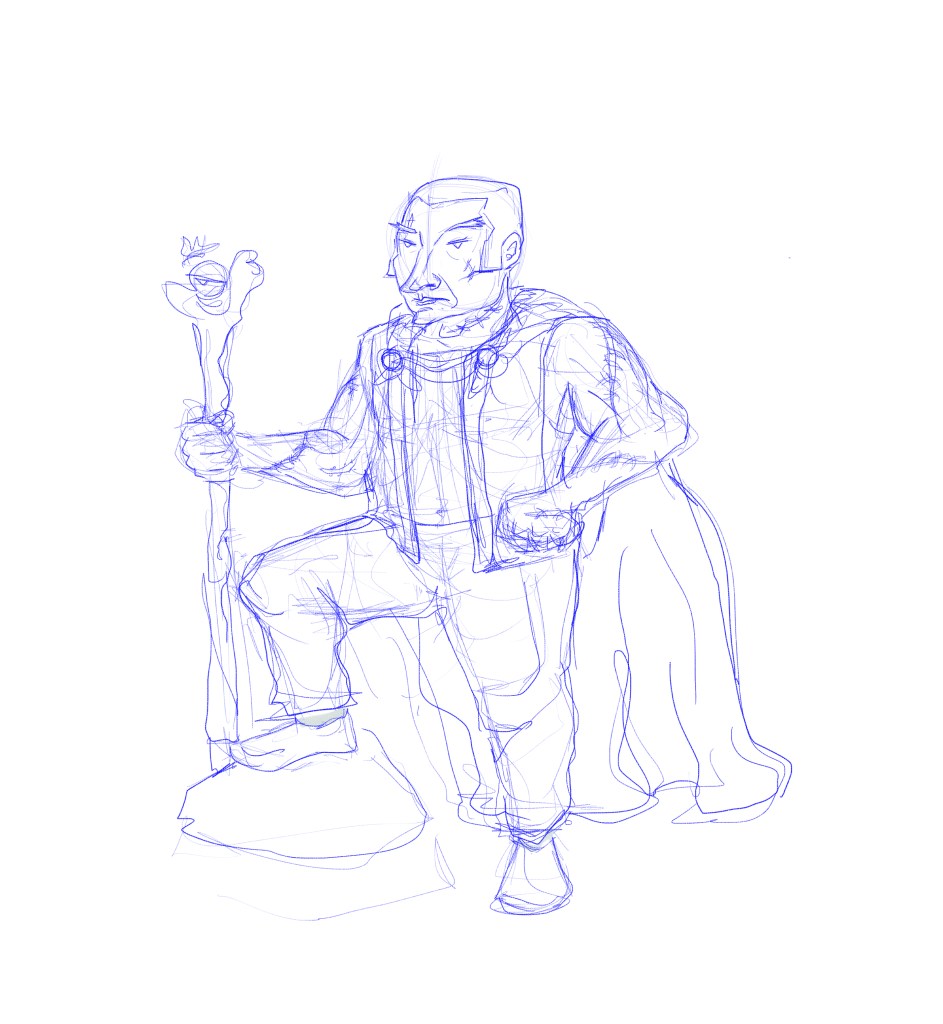
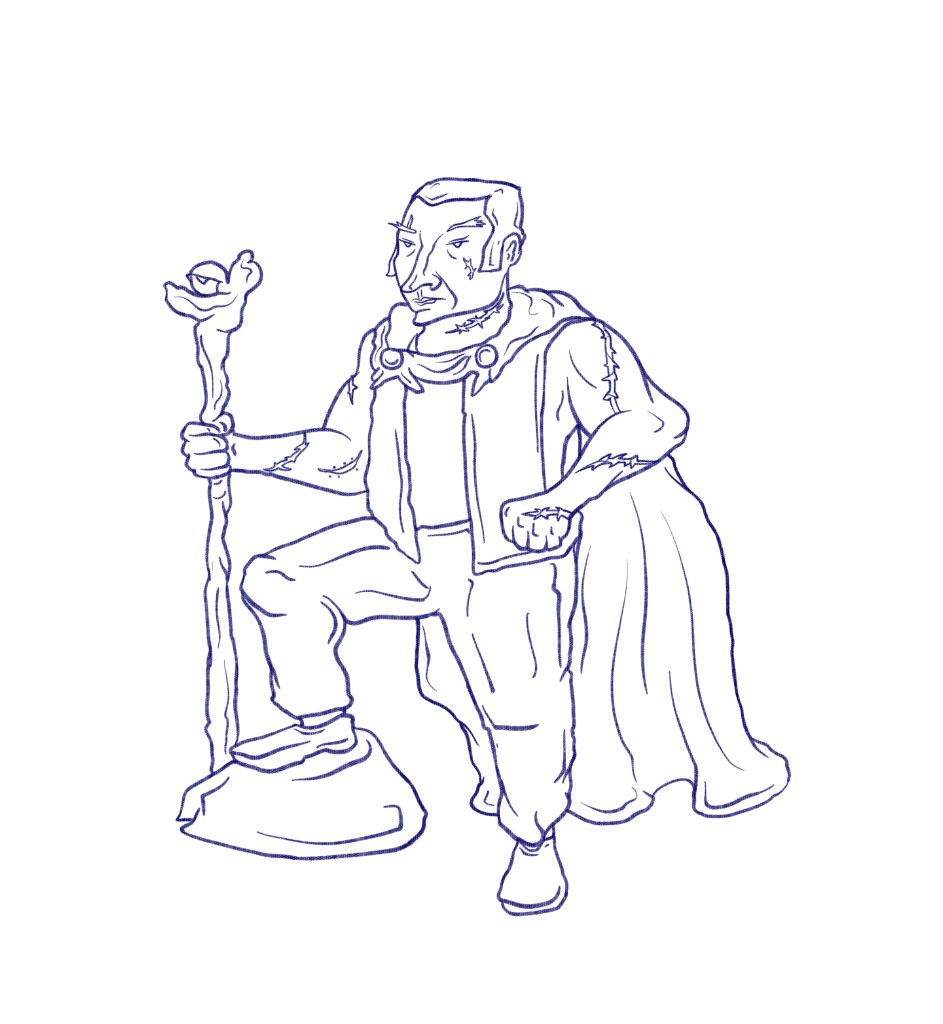
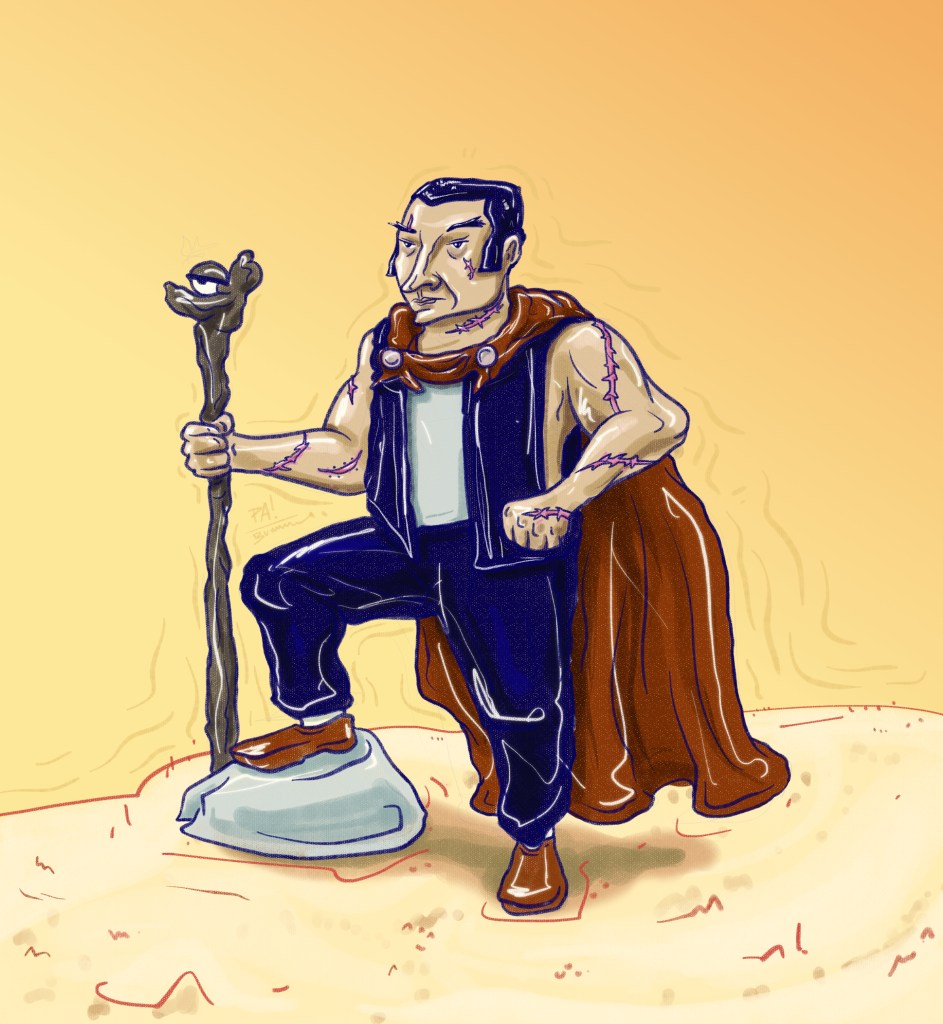
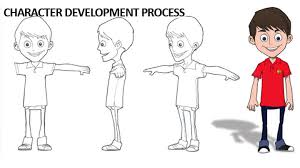
I thought I would share with you some of the process that Pablo shared with me when creating one of the villains in the story, Ian (please check his Instagram ,he is really a brilliant artist) I loved seeing my character becoming alive.
This is Ian. He is one of the villains, if not “the villain” in “The Last Families”. He is a native of Gambir (the island where the story takes place) and here is an extract of his character description:
Only the dark-haired man stepped down from his horse. His short black hair was cut into a square outline around his face. Brown eyes, tanned skin, long nose, and almost purple lips distinguished his face. He was tall and muscular. A long brown fur vest stretched down to his calves. Completing his outfit, he wore a black inner vest and dark fabric pants.
He is the leader. Mandely knew. And even if he wasn’t, he exerted authority among the other people, remaining one step in front of the others…
The last families
I’m hoping to have more information about my book’s website in a next post and share more about the process itself.
What do you think about Ian? Wanting to know more about him?
“The Last Families” is the title that I decided to give my fantasy novel. This is the first piece of fantasy I have ever tried to write. Since I didn’t feel confident to do the research required to place my story in a specific location, I decided to give the fantasy genre a shot. I soon realized that I felt comfortable with creating my own world.
After doing some research, my story falls in the category of “high-fantasy”. The definition of high fantasy, according to Wikipedia is:
High fantasy is set in an alternative, fictional (“secondary”) world, rather than the “real” or “primary” world.[2] This secondary world is usually internally consistent, but its rules differ from those of the primary world. By contrast, low fantasy is characterized by being set in earth, the primary or real world, or a rational and familiar fictional world with the inclusion of magical elements.
After giving the warning of being high-fantasy, let me tell a bit more about my story:
The last continent left on earth is perishing. Escaping through the earth’s core, the last families have reached Gambir. The island’s scorching hot sun and shores that can suck boats into a deep abyss are only some minor dangers compared to its inhabitants.
Characterized by purple, white, green, and red hair and unmistakable eye colors, each family has unique physiologies. Ninfire women can not only get pregnant in their eighties but also fly. Drontas twins die when their sibling does in spite of the family’s unnatural force. The green family, the Kaptarish, can burn anything they touch with their hands while the Verbaren– composed of only cousins since women can only have one child -used to read minds.
The apparent leader of Gambir, Ian, has set eyes on Yarisha Verbaren – the only mind-reader of the Verbaren family. But the young girl has developed feelings for Malakay, the most arrogant sibling in the Ninfire family. She knows the young man’s mother and the matriarch of the Ninfires, Mandely, will never consent to this relationship since she considers the Verbaren family to be inferior.
Meanwhile, trying to seek refuge and build a good relationship with the island’s inhabitants, Marquesh, the patriarch of the Drontas family will need to leave his wife in order to protect his children. He will get help from Palista, the old Kaptarish family matriarch. What he doesn’t know is that the old woman hides a secret and that she must hurry to pass her leadership skills to her grandson.
Soon these families will find out that skin color could determine their survival. In their quest to escape, they will uncover who is really in charge in Gambir, and learn not only from this island, but also from their inner personal strengths.
As you probably noticed, this summary has been extracted from my query letter. It is hard to summarize the story but I’m happy to talk a bit more about it in other posts.
Since I decided on self-publishing, I’m planning to set up a website for the book. A friend of mine is helping with some illustrations and they are looking fantastic so far. I’m looking forward to showing them in a next post as I delve myself into this process of self-publishing. I hope that my experience in this process will be somehow helpful to others.
What do you think of the premise of my fantasy story? I would like to hear some impressions
I usually wouldn’t have selected this book if it weren’t for a reading club at my work. We wanted to improve our writing as part of improving our communication skills – most of it is written. But why wouldn’t I pick this book if one of my main passions is writing? Because the book is directed towards nonfiction writing and when thinking of myself as a writer, I believe I’m mostly labeled as a fiction writer. But communication at work is written so it made sense to check how my writing was in the non-fictional world.
The author, William Zinsser, explains with examples (the only way to learn) how to find your own voice. He gives a huge importance in finding your true self, your true voice. He encourages you to find the passion and enjoyment in your daily writing tasks and to never forget your own principles and the ones of the story you want to talk about.
But how is the sound of our writing voices?
Your writing voice should be as you are, not how you talk, but how you perceive things in your head. Zinsser gives the following advice:
“Don’t flight such a current if it feels right. Trust your material if it’s taking you into terrain you didn’t intend to enter but where the vibrations are good…”
The right words don’t necessarily mean the complex sounding ones. “Just because they’re writing fluently doesn’t mean they’re writing well,” Zinsser mentions. How many times we read a book with lots of interesting new words, and we find ourselves wishing we had more vocabulary. But sometimes we don’t need this, we only need to find the right words, the ones specific enough to show what we mean. There is no need for complexity, rather for specificity.
When we write fictional books, we tend to overthink the writing process too much. As we write, we’re trying to sound good and to ensure our text looks not simple – not amateurish. We want others to notice we have a great vocabulary and in this effort, we sometimes lose our own voice. I have tried many times to edit my manuscripts in an effort to make the text sound smarter – not simple – but using words that weren’t true to my own rhythm and voice.
Sometimes we take too much effort in describing a scene or a character that we lose our sense of direction. “Clutter is the disease of the American writing. We are a society strangling in unnecessary words…” Zinsser mentions. And although this quote refers to American writing, it still applies to all the writing world and even to all languages. How many times I have found the same issue in my mother tongue Spanish.
Part of this clarity is to question ourselves: Is our story, the narrative, the description of scenes, and especially dialogue making sense?
Enjoying the process
We spent too much time thinking about the finished work. We tend to visualize or think too much about when the manuscript will be ready, when the book is going to be in a readable stage, and when a possible publishing time could come. We imagine the end line too often and we don’t find ourselves enjoying the process. We are writers, the process of writing should be “our thing” not going after editors and publishers. Let us enjoy the process for the time that is needed.
As Zinsser mentions: “The writer, his eye on the finish line, never gave enough thought to how to run the race,” and “You won’t write well until you understand that writing is an evolving process, not a finished product.”
How much are we willing to defend our work and to dare to be ourselves?
No matter how much editing we do ourselves, our manuscripts will suffer one day with other editors. We have to make sure that our writing and our voice are still there. “What you write is yours and nobody else’s”
I’ve struggled with this issue a lot. I want readers to recognize my voice. But sometimes, I’m so lost in having a decent product, in having precise sentences and paragraphs, good words, believable characters, believable setups, etc, that I lose my voice in it. Whatever comes out of our manuscript, it has to be ours, it has to show our own personality. As Zinsser puts it, “Writing well means believing in your writing and believing in yourself, taking risks, daring to be different, pushing yourself to excel”. This mindset is key, how many times we suppress our thoughts and expressions while we write; an inner voice saying “no, that sounds ridiculous, people won’t understand it.” But we have to understand that there is a difference between readers not able to follow a story structure and not be able to follow the author’s sense of wit and voice. We shouldn’t worry about the latter, we should just go with our guts.
We tend to forget so much of these tips. We’re scared what readers of our manuscript will say, how copywriters will find the text and how editors will see it. We’ve been told rules such as not repeating words, but sometimes they are needed for a reason, sometimes the repetition is there to provide emphasis and to give it a specific rhythm (like the double sometimes in this sentence). Many times when we change our words just to obey rules, we change the effect we are trying to give to our voice, to our characters, and to our story.
What other advice was also very helpful about this book?
Zinsser treats comedy as a good resource for writing, as a good way to show your personality. This doesn’t mean that you have to tell jokes, but it’s related to the wit with how you tell things. In most cases, this might be the best way to show the true you.
In summary, I really enjoyed the book. Even if I don’t intend to write a non-fiction book, it still had plenty of useful advice, useful not only for non-fictional writers but also for fictional writers, so I definitely recommend it. You can get the book here.
I didn’t want to write about this until I knew what I was doing. I still don’t, but I’m improving. For years, I’ve tried to build a good daily writing habit. There had been periods of time, months, when I’ve written almost every single weekday, and then months when I have written nothing. How can I achieve a good writing habit that is sustainable?
I want to be able to write every single day or at least 85% (6 of 7 days) as a permanent habit. It doesn’t matter if I only spend 30 mins, 1 hour, or more, I just want this habit to be ingrained in me, in my daily tasks, like taking a shower. I could skip one day, like those rare circumstances when you skip a shower, but more than one day?
For the previous months, I’ve been doing a re-engineering of this process, wanting to make the most of my time: balance my work with writing, personal activities, hobbies, and getting a proper rest. I’ve been failing for years, but I feel that I’m taking a sustainable approach now. How? Simple: I schedule my life priorities first, and one of them is writing.
I’ve scheduled writing for the past months for the early mornings, as the first thing I need to do when I wake up. It hasn’t been easy and I’ve completely missed the process during my vacation. But the key is to understand that this is a life priority; it should be scheduled and not added for “when you have time”. Because let’s face it, if you leave writing for when you’ve manage to organize the rest of your day, your work, your personal life, and everything else, you won’t find time for writing or you will be too tired for it.
I’ve heard that in order to make a habit, you have to repeat it twenty-one times. I don’t know if that is the magical number, but from personal experience, at least you need a whole month. My “habit making process” has been taking me several months so far. I still struggle with it, but I’ve noticed one change and it’s beginning to be forged in my mind, like taking a shower. I wake up thinking about writing and that is good enough to care for it and schedule it. I know I’m going slow – and sometimes I can only give it thirty minutes per day – but I feel that at least half-an-hour every single day will get me somewhere as opposed to no single writing for the whole week.
Any other tips I can give? To support this habit, I’ve started to meditate. I honestly suggest it. It recharges you, and it’s the only time that you actually have for yourself. If you’re not good at this or don’t know how to start, you can take a look at the Calm App.
To be honest, I’d been stuck with my manuscript for months already. Recently, I wrote how I planned to practically start over from scratch. At the end, I decided to take a similar approach, go over it but not with editing eyes (I’ve edited those sentences so many times that I didn’t know if I was actually improving them or making them worse) but read it critically, plotwise, characterwise. I felt that my biggest weakness was character development, I felt them flat. That is why I choose a very good advice from my blog friend Glynis in “Productive or Busy” (who also took it from her friend Shari) about writing separately several character pages (not necessarily related to the plot but their life story in general) to get a feeling of the characters. I loved the idea and started doing this on my current manuscript.
As soon as I started just writing, I got those chills you have when inspiration hits you and you just start typing endlessly, feeling the flow of the words. I love this state. I know I don’t do my best writing from the grammatical/structure point of view, the writing is rather awful, but I get to release all the feelings and everything I feel should be put to paper.
After this cool experience, I had to go for a fanfiction story. I know being a geek has led me to write fanfiction stories before. This is a weird path for writing since fanfiction involves writing about characters that have already been created, but it is still writing and I had to do it. It felt so liberating that I thought that I was finally rediscovering my writing spirit again. The fan fiction story only awoke my inner writing muse. This was a one time short story and it is already finished, and I don’t plan to revisit the world of fanfiction for a while, however this process has stirred the desire that I’ve been having for some time to start a new story, for leaving my manuscript resting for a while, and just start telling this new story that has been doing circles in my head.
I realized that I might not be the first one. I’m pretty sure several writers have jumped to a different work and left others to rest for a while. So I’ve started writing a new manuscript for a week already. I’ve been doing it daily (which wasn’t happening with my other writing) and I feel excited about it, ideas are flowing to my mind and I feel happy. I still plan to revisit my previous manuscript’s character pages since that aside process was been going well, but I feel like this new writing has strengthened and invigorated my new writing spirit.
And you, has it ever happened to you that you started writing other projects without finishing others? Do you think it is a good idea?
Manoush Zomorodi talks about a developed app-experiment that challenges its users to be “Bored and Briliant”.
As writers, we suffer from time to time from “writer’s block”. We find ourselves “procrastinating” and using/losing time only to check emails, social media and so on. Suddenly we find ourselves out of “ideas” or far from of a clear mind to write. The following talk might give you a different perspective:
What do you think about this talk? Do you think you can find writing inspiration during your bored times?
It has been several months since I haven’t posted a blog post. And today was the day that I decided I would not go to bed until I finally did it. Work and travel are the excuses in general – and I won’t go to discuss them more since I want to jump into blogging pools as soon as possible without lamenting why I didn’t blog these months.
My manuscript continues to be a manuscript. However, it seems it was for the best. After going through multiple reviews and editing rounds, I decided it needs a complete makeover. The story is nice, the theme topic is interesting, but it is not the book that I think it could be. I’ve struggled so much to keep the same characters and to bring to life all situations in the book, but I reached a point where I need to acknowledge that my characters might not strong enough, neither interesting enough and some situations feel awkward and forced into the plot. Maybe leaving the manuscript to rest for a long time was a good idea after all.
At this point, I’m not completely sure how to target this. Should I work on revamping the book, adjusting situations, and changing the characters over the existing framework, or just start from scratch?
Starting from scratch sounds good, but if I were to start a new complete book, then why insist on this “theme topic”? I have a couple of other better theme topics to explore. However, I cannot simply give up almost two years invested on this manuscript. Somehow, deep inside, I still want to rescue it and rescue all the time invested in it.
Loved this talk! For all of you who still hadn’t found out your passion or know what is your passion but are too afraid to pursuit, then this is the talk for you!
Actually, this is the talk for all the people who want to have a goal in life and achieve it!
Professor Larry Smiths presents, in quite a peculiar way, a talk that changes lives and inspires. He is a professor of economics at University of Waterloo. A well-known storyteller and advocate for youth leadership, he has also mentored many of his students on start-up business management and career development. The most notable start-up he advised in its infancy is Research in Motion (RIM), maker of the BlackBerry.
Invest 15 minutes in this talk and it will be an investment for life!
I usually never get spam emails. My email account filters them nicely to my spam folder. But today somehow the email below managed to get into my Inbox:
From: Jon W. Rosborough <rrjon4433@gmail.com> To: Sent: Friday, 22 July 2016, 7:25 Subject: YOUR URGENT RESPOND IS NEEDED
Wilmington International Airport
1740 Airport Blvd. Suite 12
Wilmington, NC 28405
Compliment,
Sorry for the delay in sending this message, We were checking over some files and packages in the office and we discover an ATM CARD which was addressed on your name, (I think it is Contract/Inheritances funds) I believe you can remember a dealing that has to do with some cooperate body or individual about this said funds to be deliver to you through an (ATM CARD) but I do not have any idea why it was on hold at our Airport up-to-date.
So we contacted the Authorities and they asked us to get in contact with Senator Richard Burr, to get an approval to figure out what was in the package, After checking over the ATM CARD, we discover a total sum of $5.5,000.000 ($5.5 Million USD) through the router figurative machine who check on balance through the number on a ATM CARD, so we report back to the Senator Richard Burr and we were asked to deliver the package to you from this office. (Senator Richard Burr, City Hall, Room 222 181 South Street Gastonia, NC 28052) We need you to reconfirm your full name and Home address to see if it will show on the package we have here. And also if you want your ATM CARD to be delivered to you immediately, it will cost you just only $95.00 which is the charges for the delivery clearance certificate of your ATM card, meanwhile your ATM CARD is save with our securities service so please have that in mind. The information above is where the ATM CARD was stopped at Wilmington International Airport North Carolina.
THIS MAIL IS NOT A SPAM OR SCAM MESSAGE, WE CAN DELIVER YOUR ATM CARD TODAY IF WE RECEIVED REPLY FROM YOU, I HAVE INCLUDED MY NAME AND MY SSN: 768 67 6797 FOR YOU TO KNOW THAT I AM FOR REAL AND NOT A SCAM IF YOU NEED TO VERIFY ME, SO STOP DEALING WITH ANY BODY IF YOU HAVE SOME IMPOSTERS YOU ARE DEALING WITH AND FOCUS ON GETTING YOUR ATM CARD HERE IN WILMINGTON INTERNATIONAL AIRPORT, YOU HAVE BEEN WARNED NOT TO DISCLOSE THIS DEAL TO NO ONE OR ELSE TERMINATION FROM THE HOUSE OF SENATE WILL PENETRATE ON YOUR FUNDS DUE TO THE FACT THAT YOU WERE TRYING TO CONTACT ANOTHER PERSON TO FIND OUT WHAT THIS IS, SO NO MISTAKE OF SUCH WILL BE TOLERATED.
Mr. Jon W. Rosborough
Director
As I read the email, my eyes hurt noticing all punctuation, grammar, and general writing mistakes. Since it’s Friday and I was in the mood to do something funny:
I answered the following (I doubt they’ll ever reply me):
Hi,
Thanks but this not my card. I picked up mine last month at Dulles International airport. My deal was bigger: it involved 10 million $us. But I wish you luck finding the real owner. However, you really need to polish your writing here. Below is a sample of my editing services. If you need to polish other emails like this one, send me as soon as possible to my paypal account the small amount of $us 250. I’ll be happy to assist you.
Best regards,
Lucy
Wilmington International Airport
1740 Airport Blvd. Suite 12
Wilmington, NC 28405
Compliment (what is the compliment? to address a formal email use the following words: “To whom it may concern”, “Dear xxx”, etc.)
Sorry for the delay in sending this message, (wrong punctuation. Period) We were checking over some files and packages in the office and we discover (past tense “discovered”) an ATM CARD which was addressed on (wrong preposition, use “to”) your name, (I think it is Contract/Inheritances funds)_(missing period here)I believe you can remember a dealing (a “deal”) that has to do (“is related” to?)with some cooperate body (there is no such things as “cooperate body”) or individual about this said funds to be deliver (passive voice, use: “delivered”) to you through an (ATM CARD) (no need of parentheses here) but I do not have any idea why it was on hold at our Airport up-to-date. (poor choice of words, perhaps “until now”?)
So we contacted the Authorities (no need to capitalize) and they asked us to get in contact with Senator Richard Burr, (misplaced comma) to get an approval to figure out (poor choice of words, perhaps to “find out”, “research”, etc.)what was in the package, (wrong punctuation here. You need a period)After checking over the ATM CARD, we discover (use past tense here, “discovered”) a total sum of $5.5,000.000 ($5.5 Million USD) through the router figurative machine (there is not such machine…) who (if this is a machine performing the operation, then you need to use “that”, not “who”)check (past tense: “checked”)on balance through the number on a (change it to the definite article “the”)ATM CARD, (poor writing here, this sentence is too long, you need to put a period a start another one) so we report (past tense: “reported”)back to the Senator Richard Burr and we were asked to deliver the package to you from this office. (Senator Richard Burr, City Hall, Room 222 181 South Street Gastonia, NC 28052) We need you to reconfirm your full name and Home(no need to capitalize here) address to see if it will show on the package we have here. And also (it’s poor writing to start sentences with conjunctions such as “and” followed by the connector “also”) if you want your ATM CARD to be delivered to you immediately, it will cost you just only (poor writing, avoid these words) $95.00 which is (“are”, you are referring to the “charges” which is plural) the charges for the delivery clearance certificate of your ATM card, meanwhile your ATM CARD is save (passive voice: “saved”)with our securities service so please have that in mind. The information above is where the ATM CARD was stopped (“was stopped”? do you mean “detained”, “held”…) at Wilmington International Airport North Carolina.
THIS MAIL IS NOT A SPAM OR SCAM MESSAGE, (wrong punctuation, you need to use a period) WE CAN DELIVER YOUR ATM CARD TODAY IF WE RECEIVED (you must continue the same structure here and use present “receive”)REPLY FROM YOU, (wrong punctuation, you need to use a period) I HAVE INCLUDED MY NAME AND MY SSN: 768 67 6797 FOR YOU TO KNOW THAT I AM FOR REAL AND NOT A SCAM IF YOU NEED TO VERIFY ME (poor writing, you need to rewrite the whole sentence and use a simple statement such as “…. my SSN to verify that I am not a scan.”), (Period here)SO (Stop using “so”, this is so colloquial,informal) STOP DEALING WITH ANY BODY (this is one word: “anybody”, by the way, you can’t address a person like this, it sounds like a threat and you’re losing credibility here)_ (missing punctuation here: Period) IF YOU HAVE SOME IMPOSTERS YOU ARE DEALING (you really need to check your sentence structure. It’s all over the place and there’s no coherence at all …)WITH AND FOCUS ON (is this a command, a threat? you need to polish your people skills here…) GETTING YOUR ATM CARD HERE IN WILMINGTON INTERNATIONAL AIRPORT, (wrong punctuation, you should use period to separate complete sentences)YOU HAVE BEEN WARNED NOT TO (wrong order of words “to not”) DISCLOSE THIS DEAL TO NO ONE OR ELSE TERMINATION FROM THE HOUSE OF SENATE WILL PENETRATE ON YOUR FUNDS DUE TO THE FACT THAT YOU WERE TRYING TO CONTACT ANOTHER PERSON TO FIND OUT WHAT THIS IS (terribly long sentence with no coherence at all), SO NO MISTAKE OF SUCH WILL BE TOLERATED.
Mr. Jon W. Rosborough
Director
By the way, I’m not Lucy and I don’t intend to charge $us 250. I was just in the mood of laughing today 🙂
When I started working on my first book, I had the following plan:
I would finish the draft in four of five months at most
I would make a thorough review of the first manuscript and in one single edition round I would correct everything that is wrong.
My beta readers will read it in a couple of weeks and I would rejoice in his/her wonderful comments
I would find a great Literary agent in a blink of an eye
I would have the book published in that same year
I would live from my writing and would travel the world.
I was naïve. REALLY naive.
Enter a caption
This is the second year I’m investing in my first book. I’m still editing it. So far I’ve come to understand the following:
Doing the first draft is by far the easiest and quickest part of the process
When I finished the first draft, I was so thrilled. I felt I have conquered the world and I could be called a writer. I was so proud of myself. I thought that finally I was making something good with my life, that I was looking towards the future, towards my goals, you get the point…The truth is that writing the first draft is the easiest part. You can even achieve it in one month (If you want to test the efficiency of NaNoWriMo). But rest assured the first draft will not be readable yet. Chances are it will still have lots of plot holes and huge amounts of rewrite to be done.
2. Planning one round of revision is not realistic at all
There will be many rounds of revision. It’s hard to rewrite scenes, plot holes, and work on character development while editing your grammar and punctuation at the same time. You’ll probably need another round, and perhaps a third one, etc. Additionally, after your beta readers come to you with feedback, chances are you’ll probably need to change and rewrite many sections of your book which will lead you to another round of sentence structure/grammar review, etc., again.
3. Leaving your first manuscript to rest for a couple of weeks and even a month is not a bad idea
I knew about this tip way before I finished my first manuscript. Nonetheless, I was in such a hurry of having everything done that as soon as I finished my first manuscript, I started to edit it on the very next day. I didn’t leave it to rest and breath. My head didn’t have time to clear enough to target my manuscript with a fresh point of view. The result was several pointless rounds of revision until I decided to finally give myself a break and leave the manuscript for a month. During this time, I wrote other short stories, I read more, etc. When I finally returned to my old good manuscript, my mind was fresh and I could detect more issues than in all those previous three rounds. I identified huge gaps where I could improve. If only I’ve done that before my first round of revision… I would’ve probably faced my manuscript with much better criteria from the first edition round.
4. Your beta readers won’t give you feedback in a couple of weeks
I had three good beta readers, but it took time to receive their feedback. You have to take into account that not all of them are available to read your manuscript as soon as you deliver it. Unless you’re paying for a beta reading service, most of these people will be doing you a favor. You’ll probably need to wait until they have time. Not all of them can read books in a couple of days; they might need more time. Not all of them have only your book to read; they might need to put it in their queue of “still to read books”.
5. Good Beta Readers will say the truth and cause many changes in your book
Let’s face it. This is your first book ever. You can’t expect to nail a best seller that soon. You’ll need a lot of time,experience, and good listening skills. You need to pay attention to your beta reader’s feedback. And I’m talking about good beta readers, not your mom, your husband, etc., but people who will be able to judge the manuscript and say what is in their minds without any fear of hurting your feelings. You have to acknowledge that as the author of your book, you know how the plot works, you know how characters look in your mind, but sometimes you fail to translate this knowledge into the written world. Chances are you’ll still need to change and rewrite after your beta reader’s feedback.
6. Character development is not achieved at once
If this is your first book, then you’ll probably struggle with nailing “character development”. Even if you outline characters before you start the book, they’ll probably develop and change as your plot changes. Their behaviors will change depending on how the direction of your books goes or how scenes are improved. Providing a three-dimensional character is harder than you think. It wasn’t until many revisions and feedback that I had enough tools to develop my characters as they should.
7. Developing your voice doesn’t come so fast
It doesn’t matter how many books about writing you read and how many writing courses you attend. Developing your voice only comes with practice. Sometimes, you want to obey all writing rules and make your sentences’ structure perfect, but then you find yourself with a boring flat manuscript. This doesn’t mean you don’t need to know the rules. To break the rules, you need to know them first. But you can’t expect to find your writing voice in the first round of writing. Perhaps you won’t even find it in your first book.
8. Don’t hire any editing service until you’ve received plenty feedback
I made the mistake of hiring an editing service (which was very good) before I got all the feedback. My third beta reader was able to send me his feedback after my manuscript was already edited by a professional editor. This feedback was very helpful and had lots of good advice plot-wise, which meant I had to do significant changes and rewrite many scenes and even chapters. The result, the professionally edited text was gone. It would’ve been certainly helpful to hire this service after all revisions and feedback.
9. Consider your first book may not be publishable
In my plans above, I clearly talk about getting a literary agent, publishing it, and having enough earnings to live from my writing. The reality is different. And the truth is your first book could not be published yet or could not be published at all. You need to accept this fact from the beginning. It’s a learning curve. My mind already has tons of topics to write other books; they even sound more interesting than the manuscript I’m working with right now. Perhaps book two or three will be published. Perhaps my first book will be revisited in a couple of years and later published. At this point, I only care about improving my writing.
10. This is only your first experience
Writing a first book is about gaining experience. It doesn’t matter how perfect your book idea is, how charming your characters are, or how beautifully you construct prose, the process is still tricky with the first book. You still need to learn how to handle feedback, how to detect plot holes, how to find your voice, how to make useful rounds of edition, etc. If you take this point of view, I guarantee you’ll find the experience more rewarding than the publishing result. You’ll be more excited about your next projects and you won’t suffer so much if the path of delivering your first book looks too hard. Best of all, you’ll encounter the true meaning of being a writer.